




INSEAD published this week the eleventh edition of its “Global Talent Competitiveness Index 2025: Talent and Resilience: Navigating an Era of Disruption” report. INSEAD noted that this edition of the report was co-produced for the first time with Portulans Institute, which according to the report adds value from the expertise of Portulans Institute in digital transformation, innovation metrics and global indices that complement the leadership of INSEAD in the talent and human capital space. The report stated that although the GTCI’s foundations remain strong, the global context has changed due to the geopolitical tensions, climate risks, and the quick development in Artificial Intelligence (AI) that transformed talent into a pillar of the resilience & transformation of societies. According to the report, the geopolitical uncertainty presents substantial challenges to the resilience of global commerce and markets while AI presents opportunities to improve the potential of humans on the one hand yet it comes with “unfathomable” risks on the other. The GTCI is prepared as an Input-Output model that combines an analysis of what countries do to produce and acquire talent (input) along with an evaluation of the resulting skills and competencies available (output). The report noted that the Input-Output model of the index comprises six pillars that define a nation’s talent competitiveness in addition to its ability to attract, grow, and retain human capital, in order to convert these efforts into talent outcomes that can be measured. More specifically, the Input sub-index is composed of four pillars (Enable, Attract, Grow, and Retain) that are responsible for capturing the institutional, regulatory, and policy determinants of the national talent ecosystems, while the two pillars of the Output sub-index (Vocational and Technical Skills (VT Skills), and Generalist Adaptive Skills (GA Skills)) reflect the outcomes of the aforementioned inputs regarding skills availability and their impact on productivity and innovation.
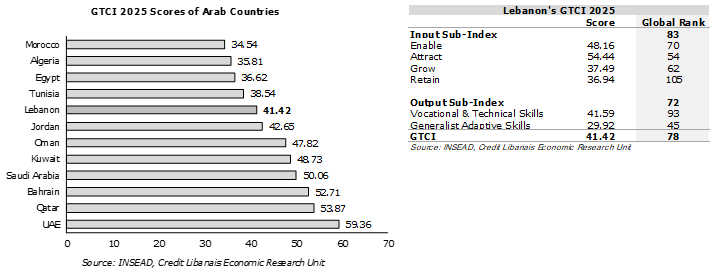
The INSEAD 2025 GTCI report is made up of 77 indicators and covers 135 countries, which together represent more than 97% of global GDP and 93% of the world’s population. In detail, and on a global level, Singapore came in first in the world in the 2025 GTCI with a score of 73.29, followed by Switzerland (score: 73.14), Denmark (score: 72.05), Finland (score: 71.06) and Sweden (score: 70.76) among others. On a regional basis, the United Arab Emirates came first in the GTCI 2025 rankings of Arab countries with a score of 59.36 (global rank: 25), followed by Qatar (score: 53.87; global rank: 35), Bahrain (score: 52.71; global rank: 38), and Saudi Arabia (score: 50.06; global rank: 48), only to name a few. Lebanon scored 41.42 in the GTCI 2025, placing it in the 8th position among its Arab peers and 78th in the world. In detail, Lebanon ranked 83rd globally in the Input Sub-Index and 72nd in the Output Sub-Index. On the Input Sub-Index front, Lebanon ranked 70th in the world in the talent enabling pillar (score: 48.16), 54th in the talent attraction pillar (score: 54.44), 62nd in the talent growth pillar (score: 37.49), and 105th in the talent retention pillar (score: 36.94). With respect to the Output Sub-Index, Lebanon positioned 93rd in the “Vocational and Technical Skills” criterion (score: 41.59) and 45th in the “Generalist Adaptive Skills” criterion (score: 29.92). Lebanon’s best performance on the “Enable” front was in the field of Enterprise Software (score: 100; global rank: 1), on the “Attract” front in the field of Financial Globalization (score: 83.62; global rank: 21), on the “Grow” front in the field of Use of Virtual Networks (score: 68.24; global rank: 62), on the “Retain” front in the field of Sanitation (score: 99.08; global rank: 28), on the “Vocational & Technical Skills” front in the field of Ease of Finding Skilled Employees (score: 73.66; global rank: 5), and on the “Generalist Adaptive Skills” front in the field of Mobile Apps Development (score: 72.70; global rank: 27).
أصدرت جامعة إنسياد (INSEAD) هذا الأسبوع النسخة الحادية عشر من تقريرها المُعنوَن "المؤشّر العالمي للقدرة التنافسيّة للمواهب للعام 2025: الإنتقال عبر عصرٍ من الإضطراب". أشارت جامعة إنسياد أنّه تمّ إعداد هذه النسخة من التقرير بالتعاون مع مؤسّسة بورتولانز والتي بحسب إنسياد كان لها قيمة مضافة من خلال خبرتها في التحوّل الرقميّ ومقاييس الإبتكار والمؤشّرات العالميّة والتي تكمّل قيادة جامعة إنسياد في مجالات المواهب والرأسمال البشري. وقد ذكر التقرير أنّه بالرغم من صلابة أسس المؤشّر العالمي للقدرة التنافسيّة للمواهب، فإنّ السياق العالمي قد تغيّر بسبب التوتّرات الجيوسياسيّة والمخاطر المناخيّة والتطوّر السريع في الذكاء الإصطناعي والذي حوّل المواهب لتصبح ركيزة للمرونة والتحوّل في المجتمعات. وبحسب التقرير، فإنّ عدم اليقين الجيوسياسي يقدّم تحدّيات جمّة لمرونة التجارة والأسواق العالميّة في حين أنّ الذكاء الإصطناعي يقدّم فرص لتحسين إمكانات البشر من جهة إلاّ أنّ هذه التحسينات تأتي معها مخاطر لا يمكن فهمها من جهةٍ أخرى. يتمّ تحضير المؤشّر العالمي للقدرة التنافسيّة للمواهب كنموذج إستقطاب وتصدير (Input-Output Model) للمواهب والذي يجمع من جهة الطرق التي تقوم بها البلدان بإنتاج وإستقطاب المواهب (Input Sub-Index) ومن جهةٍ أخرى يقيّم المهارات والمواهب المتوفّرة (Output Sub-Index). وقد ذكر التقرير أنّ نموذج الإستقطاب والتصدير التابع للمؤشّر يتكوّن من ستّة ركائز والتي تعرّف عن القدرة التنافسيّة للمواهب إضافةً إلى قدرتها على جذب وتحسين والحفاظ على الرأسمال البشري من أجل تحويل هذه الجهود إلى نتائج مواهب قابلة للقياس. بالتفاصيل، يتضمّن مؤشّر إستقطاب المواهب أربعة عوامل (قدرة دولة ما على تمكين، جذب، تطوير، والمحافظة على المواهب) مسؤولة عن إلتقاط المقوّمات المؤسساتيّة والنظاميّة والسياساتيّة لمنظومات المواهب الوطنيّة في حين أنّ العاملين التابعين لمؤشّر تصدير المواهب (المهارات المهنيّة والتقنيّة والمهارات التكيفيّة العامّة) تعكس نتائج الإستقطابات لجهة توفّر المهارات وتأثيرها على الإنتاجيّة والإبتكار.
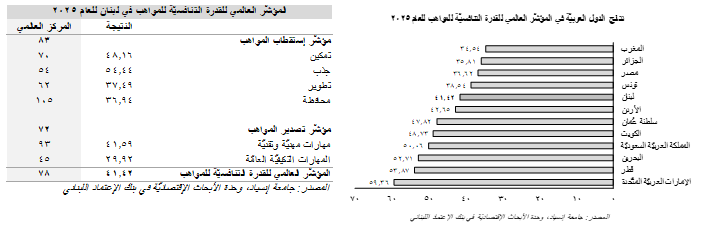
يتألّف تقرير جامعة إنسياد للعام 2025 من 77 مؤشّر وهو يشمل 135 دولة تشكّل أكثر من 97% من الناتج المحلّي الإجمالي العالمي و93% من عدد سكّان العالم. بالتفاصيل، وعلى الصعيد العالمي، حلّت سنغافورة في المرتبة الأولى في المؤشّر العالمي للقدرة التنافسيّة للمواهب عن العام 2025 بنتيجة 73.29، تبعتها سويسرا (النتيجة: 73.14) والدنمارك (النتيجة: 72.05) وفنلندا (النتيجة: 71.06) والسويد (النتيجة: 70.76). إقليميّاً، جاءت دولة الإمارات العربيّة المتحّدة في المركز الأوَّل في المؤشّر العالمي للقدرة التنافسيّة للعام 2025 مُسجِّلةً نتيجة 59.36 (المركز العالمي: 25)، تَبِعَتها كلٌّ من قطر (النتيجة: 53.87؛ المركز العالمي: 35) والبحرين (النتيجة: 52.71؛ المركز العالمي: 38) والمملكة العربيّة السعوديّة (النتيجة: 50.06؛ المركز العالمي: 48) للذكر لا للحصر. أمّا بالنسبة للبنان، فقد سجّل هذا الأخير نتيجة 41.42 في المؤشّر المذكور ليحتلّ بذلك المركز الثامن عربيّاً والمركز ال78 عالميّاً. بالتفصيل، جاء لبنان في المرتبة 83 عالميّاً في مؤشّر إستقطاب المواهب والمركز 72 في مؤشّر تصدير المواهب. وعلى صعيد مؤشّر إستقطاب المواهب، إحتلّ لبنان المركز ال70 في العالم في عامل تمكين المواهب (النتيجة: 48.16) و54 في عامل جذب المواهب (النتيجة: 54.44) و62 في عامل تطوير المواهب (النتيجة: 37.49) و105 في عامل المحافظة على المواهب (النتيجة: 36.94). وفيما يختصّ بمؤشّر تصدير المواهب، جاء لبنان في المرتبة 93 عالميّاً في عامل المهارات المهنيّة والتقنيّة (النتيجة: 41.59) وال45 في عامل المهارات التكيفيّة العامّة (النتيجة: 29.92). بالإضافة إلى ذلك، سجّل لبنان أداءه الأفضل على صعيد "التمكين" في مجال برمجيّات المؤسّسات (النتيجة: 100؛ المركز العالمي: 1) وعلى صعيد "الجذب" في مجال العولمة الماليّة (النتيجة: 83.62؛ المركز العالمي: 21) وعلى صعيد "التطوير" في مجال إستعمال الشبكات الإفتراضيّة (النتيجة: 68.24؛ المركز العالمي: 62) وفي ما خصّ "المُحافظة" في مجال الصرف الصحّي (النتيجة: 99.08؛ المركز العالمي: 28) وعلى صعيد "المهارات المهنيّة والتقنيّة" في مجال سهولة العثور على موظّفين ذوي مهارة عالية (النتيجة: 73.66؛ المركز العالمي: 5) وفي إطار "المهارات التكيفيّة العامّة" في مجال تطوير تطبيقات الهاتف المحمول (النتيجة: 72.70؛ المركز العالمي: 27).