




The Tax Justice Network (TJN) recently launched its “Financial Secrecy Index 2025”, which assesses the level of financial secrecy and the scale of offshore financial activities in 141 jurisdictions across the globe, and helps track tax havens and illicit financial flows. In details, the TJN assigned each jurisdiction a Secrecy Score ranging between 0 (full transparency) and 100 (full secrecy) based on 20 indicators, namely: Banking Secrecy, Beneficial Ownership of Trusts, Beneficial Ownership of Foundations, Beneficial Ownership of Companies, Freeports Ownership, Real Estate Ownership, Transparency of Partnerships with Limited Liability, Transparency of Company Ownership, Transparency of Company Accounts, Public Country-by-Country Reporting, Legal Entity Identifier, Tax Compliance Focus, Golden Visas, Foreign Investment Income, Public Statistics, Tax Rulings and Extractive Industries’ Contracts, Anti-Money Laundering, Automatic Exchange of Information, Information Exchange Upon Request, and International Legal Cooperation. In addition, the TJN stated that the index also includes a Global Scale Weight (GSW), which assesses the size of each jurisdiction’s share of the global market for financial services provided. According to the TJN report, the more financial services a jurisdiction provides, the larger the potential threat if the jurisdiction in question is not fully transparent. The Financial Secrecy Index (FSI) is then calculated by multiplying the cube of the previously mentioned Secrecy Score by the cubic root of the GSW (i.e. a jurisdiction's share in global financial services exports), and then dividing the result by 100. The jurisdictions are subsequently ranked according to their respective FSI Value. In this vein, the TJN noted that a bigger supplier of financial secrecy doesn’t always translate into a more secretive jurisdiction.
According to the TJN, countries included in the index are losing $492 billion in tax revenues a year due to global tax abuse by multinational corporations and wealthy individuals. Furthermore, the TJN report noted that out of the $492 billion in tax loss, over a third ($145 billion) is lost due to offshore tax evasion by wealthy individuals. The TJN commented, however, that financial secrecy does not only facilitate tax evasion, but also fosters fraud, money laundering, enables corruption, and other illicit activities.
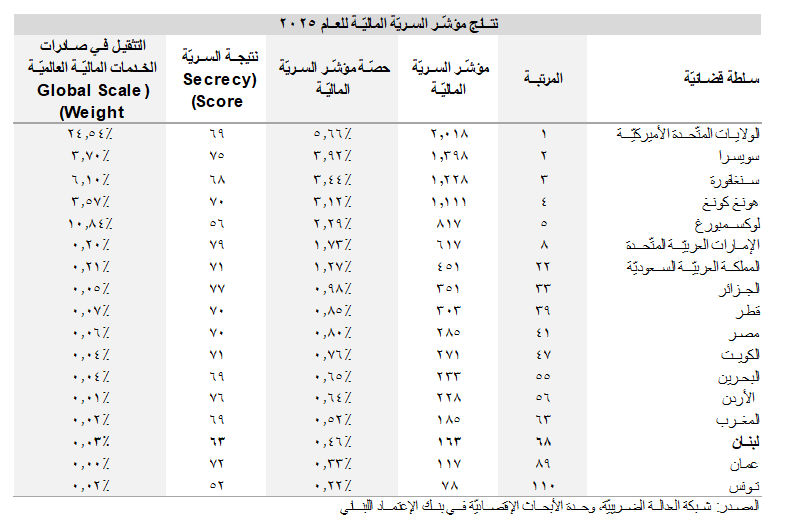
In figures, the United States topped the list of covered jurisdictions in the 2025 Financial Secrecy Index, with an FSI Value of 2,018 signifying that the U.S. is the largest enabler of financial secrecy worldwide, followed by Switzerland (FSI Value: 1,398), Singapore (FSI Value: 1,228), Hong Kong (FSI Value: 1,111), and Luxembourg (FSI Value: 817). The United Arab Emirates emerged as the largest regional enabler of financial secrecy ranking also 8th globally in the 2025 index with an FSI Value of 617, followed by Saudi Arabia (global rank: 22, FSI Value: 451), Algeria (global rank: 33, FSI Value: 351), and Qatar (global rank: 39, FSI Value: 303), only to name a few.
Lebanon ranked 68th in the world and 10th regionally in the 2025 Financial Secrecy Index (vs 77th globally and 10th regionally in the previous version of the index), registering an FSI Value of 163 (vs 149 previously). In fact, Lebanon recorded a Secrecy Score of 63 (64.6 previously) and a relatively low FSI share of 0.46% (0.44% previously), meaning that the country’s financial services exports represent a meager 0.46% of the world’s total. Lebanon recorded full transparency in 4 out of 20 indicators and full secrecy in 9 indicators.
أصدرت شبكة العدالة الضريبيّة مؤخَّراً نتائج مؤشّر السريّة الماليّة للعام 2025، والذي تقيّم من خلاله مستوى السريّة الماليّة والنشاط المالي الأوفشور في 141 دولة حول العالم، وتساهم في رصد الملاذات الضريبيّة والتدفّقات الماليّة غير الشرعيّة. في التفاصيل، تعطي شبكة العدالة الضريبيّة نتيجةً للسريّة الماليّة (Secrecy Score) تتراوح بين ال0 (شفافيّة كاملة) وال100 (سريّة كاملة) مستندةً على 20 معيار، ألا وهي: السريّة المصرفيّة وأصحاب الحق الإقتصادي للصناديق وأصحاب الحق الإقتصادي للمؤسّسات وأصحاب الحق الإقتصادي للشركات وملكيّة المناطق الحرّة وملكيّة العقارات وشفافيّة الشراكة المحدودة المسؤوليّة وشفافيّة ملكيّة الشركات العامّة وشفافيّة حسابات الشركات العامّة والتقارير العامّة على أساس كلّ بلد ومعرّف الكيان القانوني والتركيز على الإمتثال الضريبي والتأشيرات الذهبيّة والدخل من الإستثمار الأجنبي والإحصاءات العامّة والأحكام الضريبيّة وعقود الصناعات الإستخراجيّة ومكافحة غسل الأموال والتبادل التلقائي للمعلومات وتبادل المعلومات عند الطلب والتعاون القانوني الدولي. وقد أشارت شبكة العدالة الضريبيّة إلى أنّ المؤشّر يرتكز على تثقيل لكلّ بلدٍ في صادرات الخدمات الماليّة العالميّة (Global Scale Weight) والذي يقيّم حجم حصّة كلّ بلد من الخدمات الماليّة الممنوحة. ووفقاً لشبكة العدالة الضريبيّة، كلّما زادت الخدمات الماليّة التي يمنحها كلّ بلد، كلّما زاد الخطر المحتمل في حال لم يكن البلد المعني شفّاف بالكامل. يتمّ بعد ذلك إحتساب مؤشّر السريّة الماليّة من خلال ضرب مكعّب النتيجة المذكورة سابقاً بالجذر التكعيبي للمؤشّر الذي يقيس تثقيل كلّ بلدٍ في صادرات الخدمات الماليّة العالميّة، ومن ثمّ قسم النتيجة ب100. تُصنَّف بعد ذلك الدول بحسب النتيجة في مؤشّر السريّة الماليّة. في هذا الإطار، أشارت شبكة العدالة الضريبيّة أنّ حجم صادرات خدمات ماليّة كبير لا يعني دائماً أنّ البلد المعني يتمتّع بسريّة أعلى من بلد أخر.
وبحسب شبكة العدالة الضريبيّة، فقد خسرت البلدان المشمولة في المؤشّر حوالي 492 مليار د.أ. في العام 2024 على شكل إيرادات ضريبيّة في ظلّ التهرّب الضريبي العالمي من قبل شركات دوليّة وأفراد أثرياء. وقد أشارت شبكة العدالة الضريبيّة إلى أنّ أكثر من ثلث الخسائر على الإيرادات الضريبيّة (حوالي 145 مليار د.أ.) نتجت عن التهرّب الضريبي الأوفشور من قبل الأثرياء. ولكّن شبكة العدالة الضريبيّة قد ذكرت أنّ السريّة الماليّة لا تسهِّل فقط عمليّة التهرّب الضريبي، بل تعزِّز أيضاً عمليّات الإحتيال، وتبييض الأموال، وتمكين الفساد، وأنشطة أخرى غير مشروعة.
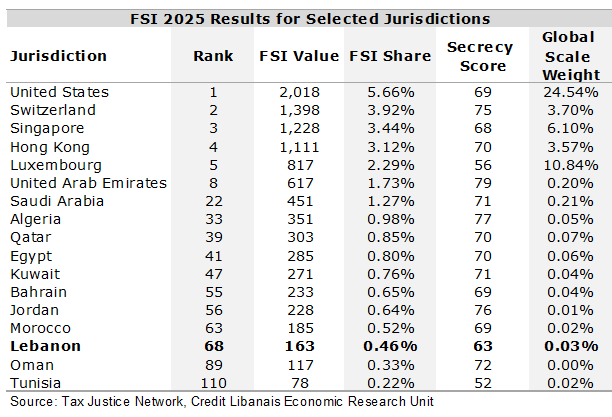
بالأرقام، أتت الولايات المتّحدة في الصدارة في مؤشّر السريّة الماليّة للعام 2025 مسجّلةً نتيجة 2،018 ممّا يعني بأنّ الولايات المتّحدة الأميركيّة هي أكبر مسهّل للسريّة الماليّة عالميّاً تبعتها سويسرا (النتيجة: 1،398) وسنغافورة (النتيجة: 1،228) وهونغ كونغ (النتيجة: 1،111) ولوكسمبورغ (النتيجة: 817). وقد تصدّرت الإمارات العربيّة المتّحدة اللائحة بين البلدان العربيّة كما وأتت في المرتبة الثامنة في العالم في مؤشّر العام 2025 مسجلّةً نتيجة 617، تبعتها المملكة العربيّة السعوديّة (المرتبة العالميّة: 22، النتيجة: 451) والجزائر (المرتبة العالميّة 33:، النتيجة: 351) وقطر (المرتبة العالميّة: 39، النتيجة: 303) للذكر لا للحصر.
وقد أتى لبنان في المرتبة 68 في العالم والعاشرة في المنطقة في مؤشّر السريّة الماليّة للعام 2025 (مقارنةً بالمرتبة 77 عالميّاً والعاشرة إقليميّاً في النسخة السابقة من التقرير)، محقِّقاً نتيجة 163 (149 سابقاً). وقد سجّل لبنان نتيجة 63 في مؤشّر السريّة الماليّة (64.6 سابقاً)، في حين بقي تثقيله منخفضاً عند 0.46% (0.44% سابقاً) لناحية صادرات الخدمات الماليّة العالميّة. بمعنى آخر، شكّلت صادرات لبنان من الخدمات الماليّة نسبة 0.46% من مجموع الصادرات العالميّة للخدمات الماليّة. وقد سجّل لبنان سريّة كاملة في 9 من أصل 20 مؤشّر، في حين سجّل شفافيّة كاملة في 4 مؤشّرات.