




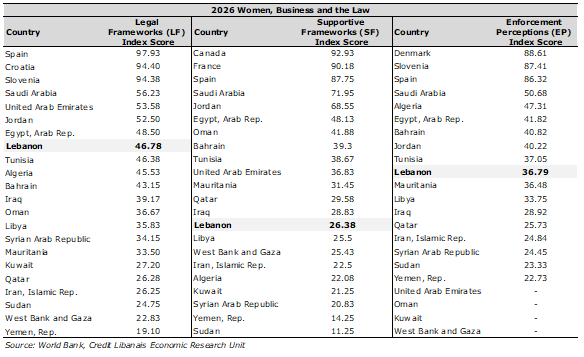
The World Bank published this week the 11th edition of its report titled “Women, Business and the Law 2026: Benchmarking Laws for Jobs and Inclusive Growth” in which it examines the legal policy and practical factors shaping women’s economic opportunities across 190 countries around the globe through three indices embedding 40 indicators each that help shape women’s economic decisions during various phases of their lives. These indicators are grouped into 10 topics each, namely “Safety”, “Mobility”, “Work”, “Pay”, “Marriage”, “Parenthood”, “Childcare”, “Entrepreneurship”, “Assets”, and “Pension”. The findings of the 2026 edition of the report are divided into 3 indices. The aforementioned indices are: the Legal Frameworks (LF) index, which measures the degree of equality of rights, the Supportive Frameworks (SF) index which examines policies, institutions, and data systems to support the implementation of laws, and the Enforcement Perceptions (EP) index which is a gauge on how well public authorities are enforcing these laws. In this vein, the report revealed that there is a noticeable imbalance among the equal laws, the systems designed for their implementation, as well as their enforcement. More specifically, the report noted that the global average score of the LF index stood at 67 in 2026, which signifies that a large gap persists between the current legal standards and equality of rights under the law. In addition, the global average score of the SF index attained 47 out of 100, meaning that less than 50% of the systems required to implement gender equality laws are in place. Furthermore, the global average score of the EP index reached 53 in 2026, which indicates that women’s rights are being partially enforced. According to the report, the index scores range between 0 and 100. The findings of the Women, Business and the Law report revealed that none of the 190 countries included in the report managed to score 100 in any of the three indices. In detail, 14 countries (namely Spain, Croatia, Slovenia, France, Italy, Ireland, Australia, Greece, Lithuania, Belgium, Portugal, Austria, Romania, and New Zealand) managed to score 90 and above in the LF index, while 2 countries (Canada and France) scored over 90 in the SF index and no countries managed to score 90 or above in the EP index. On a global basis, Spain came in first in the LF index with a score of 97.93 and was followed by Croatia (score of 94.40) and Slovenia (score of 94.38). Canada obtained the highest score in the SF index (92.93), and was closely followed by France (score of 90.18) and Spain (score of 87.75). Denmark received the highest score of 88.61 in the EP index and was followed by Slovenia (score of 87.41) and Spain (score of 86.32). In the Middle East and North Africa (MENA) region, Saudi Arabia was the top performer in the LF index with a score of 56.23, followed by the United Arab Emirates (score of 53.58) and Jordan (score of 52.50). Saudi Arabia was also the top performer in the SF index, scoring 71.95, followed by Jordan (score of 68.55) and Egypt (score of 48.13). Saudi Arabia was the top performer in the EP index, with a score of 50.68, followed by Algeria (score of 47.31) and Egypt (score of 41.82). Locally, the World Bank assigned Lebanon a score of 46.78 in the LF index, the fifth highest in the MENA region. Lebanon also scored 26.38 in the SF index (11th highest in the MENA region) and 36.79 in the EP index (7th highest in the MENA region). In the LF index, Lebanon fared best in each of the “Mobility” and “Work” topics (score of 75.00) and worst in each of the “Entrepreneurship”, “Assets” and “Pension” topics (score of 25.00). In the SF index, Lebanon scored highest in the “Safety” topic (score of 56.25) and lowest in each of the “Marriage”, “Parenthood”, and “Pension” topics (score of 0.00). In the EP index, Lebanon achieved its highest score in the “Mobility” topic (score of 84.38) and lowest score in the “Childcare” topic (score of 18.75).
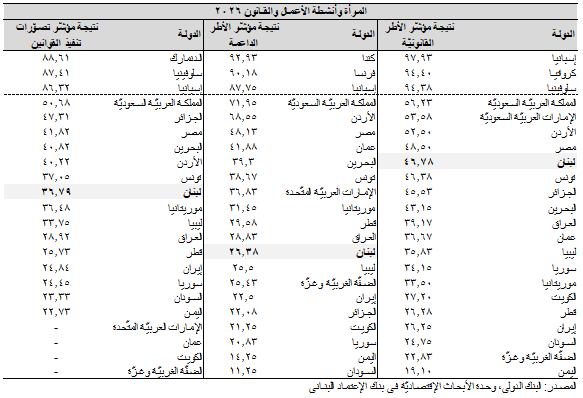
أصدَرَ البنك الدولي هذا الأسبوع النسخة الحادية عشر من تقرير "المرأة وأنشطة العمل والقانون 2026: تقييم التشريعات لفرص عملٍ أفضل ونموٍ أشمل" درس فيه السياسات القانونيّة والعوامل العمليّة التي تشكّل فرص إقتصاديّة للنساء في 190 دولة حول العالم وذلك عبر ثلاثة مؤشّرات تشمل 40 معيار في كلّ مؤشّر والتي تساعد النساء في صنع القرارات الإقتصاديّة خلال المراحل المختلفة من حياتهّن. يتمّ إحتواء تلك المعايير ضمن عشر خانات وهي: "السلامة" و"التنقّل" و"العمل" و"الأجور" و"الزواج" و"الوالديّة" و"رعاية الأطفال" و"ريادة الأعمال" و"الأصول" و"المعاش التقاعدي". إنّ المؤشرات الثلاث المذكورة آنفاً هي مؤشّر الأطر القانونيّة والذي يقيس نسبة المساواة في الحقوق بين الجنسين ومؤشّر الأطر الداعمة والذي يدرس سياسات المؤسّسات وأنظمة المعلومات لمساندة تطبيق قوانين المساواة بين الجنسين ومؤشّر تصوّرات تنفيذ القوانين والذي يقيس قدرة المؤسّسات العامّة على تطبيق تلك القوانين. في هذا الإطار، كشف التقرير عن وجود إختلال ملحوظ بين قوانين المساواة بين الجنسين والأنظمة الداعمة لتطبيقها. بالتفاصيل، أشار التقرير إلى أنّ المتوسّط العالمي لنتيجة مؤشّر الأطر القانونيّة قد بلغ 67 على 100 ما يعني وجود فجوة كبيرة بين المعايير القانونيّة الحاليّة والمساواة بين الجنسين تحت إطار القانون. بالإضافة إلى ذلك، فإنّ المتوسّط العالمي لنتيجة مؤشّر الأطر الداعمة قد ناهزا ال47 على 100 ما يعني أنّ أقلّ من نصف الأنظمة المطلوبة لدعم تنفيذ تلك القوانين تعتبر متوفّرة. كذلك أشار التقرير أنّ المتوسّط العالمي لنتيجة مؤشّر تصوّرات تنفيذ القوانين قد بلغ 53 على 100 ما يعني أنّ حقوق المرأة تطبّق جزئيّاً. وبحسب التقرير، فإنّ نتائج المؤشّرات تتراوح بين 0 و100 حيث أنّ نتيجة 0 هي أدنى نتيجة ممكنة و100 هي الأعلى. وتكشف أرقام التقرير بأنّه لم تتمكّن أيّ دولة من تحقيق نتيجة 100 في أيّ من المؤشّرات الثلاثة. بالتفاصيل، فإنّ 14 دولة (إسبانيا وكرواتيا وسلوفينيا وفرنسا وإيطاليا وإيرلندا وأستراليا واليونان وليتوانيا وبلجيكا والبرتغال والنمسا ورومانيا ونيوزيلندا) قد حقّقت نتيجة 90 أو ما فوق في مؤشّر الأطر القانونيّة، في حين أنّ دولتين (وهي كندا وفرنسا) قد حقّقتا نتيجة تفوق ال90 في مؤشّر الأطر الداعمة في حين لم تتمكّن أيّ دولة من تحقيق نتيجة تفوق ال90 في مؤشّر تصوّرات تنفيذ القوانين. على الصعيد العالمي، أتت إسبانيا في المرتبة الأولى في مؤشّر الأطر القانونيّة مع تسجيلها نتيجة 97.93 تبعتها كرواتيا (نتيجة 94.40) وسلوفينيا (نتيجة 94.38). وقد حقّقت كندا النتيجة الأعلى في مؤشّر الأطر الداعمة عند 92.93، متبوعةً من فرنسا (نتيجة 90.18) وإسبانيا (نتيجة 87.75). وقد حصلت الدنمارك على أفضل نتيجة في مؤشّر تصوّرات تنفيذ القوانين عند 88.61، تلتها سلوفينيا (نتيجة 87.41) وإسبانيا (نتيجة 86.32). أمّا بالنسبة لمنطقة الشرق الأوسط وشمال إفريقيا، فقد سجّلت المملكة العربيّة السعوديّة أعلى نتيجة في مؤشّر الأطر القانونيّة عند 56.23، تبعتها الإمارات العربيّة المتّحدة (نتيجة 53.58) والأردن (نتيجة 52.50). وقد حصلت المملكة العربيّة السعوديّة أيضاً على أفضل نتيجة في مؤشّر الأطر الداعمة عند 71.95 تلتها الأردن (نتيجة 68.55) ومصر (نتيجة 48.13). كذلك سجّلت المملكة العربيّة السعوديّة أفضل نتيجة في مؤشّر تصوّرات تنفيذ القوانين عند 50.68 تبعتها الجزائر (نتيجة 47.31) ومصر (نتيجة 41.82). محليّاً، سجّل لبنان نتيجة 46.78 في مؤشّر الأطر القانونيّة (المرتبة الخامسة في المنطقة) كما وسجّل نتيجة 26.38 في مؤشّر الأطر الداعمة (المرتبة الحادية عشر في المنطقة) ونتيجة 36.79 في مؤشّر تصوّرات تنفيذ القوانين (المرتبة السابعة في المنطقة). في مؤشّر الأطر القانونيّة، حقّق لبنان أفضل نتيجة في معياريّ "التنقّل" و"العمل" (نتيجة 75.00 في كلٍّ منها) والأسوأ في معايير "الريادة الأعمال" و"الأصول" و"المعاش التقاعدي" (نتيجة 25.00 في كلٍّ منها). بالنسبة لمؤشّر الأطر الداعمة، كانت نتيجة لبنان الأعلى في معيار "السلامة" (نتيجة 56.25) والأدنى في معايير "الزواج" و"الوالديّة" و"المعاش التقاعدي" (نتيجة 0.00). أمّا لجهة مؤشّر تصوّرات تنفيذ القوانين، فقد حقّق لبنان أفضل نتيجة له في معيار "التنقّل" (نتيجة 84.38) والأدنى في معيار "رعاية الأطفال" (نتيجة 18.75).