





The World Bank recently updated its Worldwide Governance Indicators (WGI) database for the year 2024 through which it published the results registered by more than 200 countries and territories under six governance dimensions, namely “Voice and Accountability”, “Political Stability and Absence of Violence”, “Government Effectiveness”, “Regulatory Quality”, “Rule of Law”, and “Control of Corruption”. In fact, each country was assigned a governance estimate ranging between -2.50 (weak governance) and 2.50 (strong governance) and given a governance score which maps the governance estimate on a scale of 0 to 100.
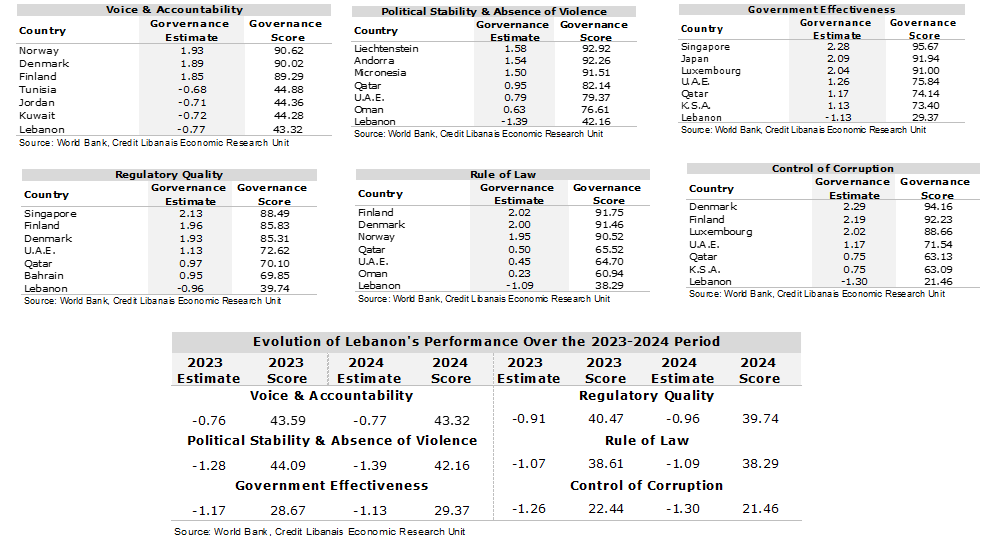
On a global basis, Norway ranked first in the “Voice and Accountability” dimension for yet another consecutive year with a governance estimate of 1.93, while Liechtenstein ranked 1st in “Political Stability and Absence of Violence” with an estimate of 1.58, Singapore positioned best in each of “Government Effectiveness” (estimate: 2.28) and “Regulatory Quality” (estimate: 2.13), Finland came in the 1st place in the “Rule of Law” dimension with an estimate of 2.02, and Denmark emerged in the first position in the “Control of Corruption” dimension (estimate: 2.29).
Regionally, the United Arab Emirates (U.A.E.) dominated the “Government Effectiveness” (governance estimate: 1.26; score: 75.84), Regulatory Quality (governance estimate: 1.13; score: 72.62), and “Control of Corruption” (governance estimate: 1.17; score: 71.54) dimensions. Qatar outperformed its regional peers in both the “Political Stability and Absence of Violence” (governance estimate: 0.95; score: 82.14) & the “Rule of Law” (governance estimate: 0.50; score: 65.52) dimensions, while Tunisia came first in the “Voice and Accountability” (governance estimate: -0.68; score: 44.88) dimension. Lebanon’s performance was rather weak across all indicators as depicted by its negative governance estimates, with its best performance being in the voice and accountability indicator (estimate of -0.77) and its worst being in the political stability & absence of violence indicator (estimate of -1.39). Furthermore, Lebanon reported a deterioration in all of the covered dimensions except for Government Effectiveness. This is further depicted by the below tables:
حَدَّثَ البنك الدولي مؤخَّراً قاعدة بياناته حول مؤشِّرات الحوكمة العالميّة للعام 2024 عَرَضَ من خلالها النتائج التي سجَّلتها أكثر من 200 دولةٍ وإقليمٍ لناحية ستّة أبعادٍ للحوكمة، ألا وهي: الصوت والمحاسَبة، الإستقرار السياسي وغياب العنف، فعاليّة الحكومة، جودة التشريع، سيادة القانون، والسيطرة على الفساد. في التفاصيل، حَصَدَ كلّ بلدٍ مستوى تقديري للحوكمة يتراوح بين -2.50 (حوكمة ضعيفة) و2.50 (حوكمة قويّة)، بالإضافة إلى نتيجة (بناءً على المستوى التقديري) تتراوح بين الصفر والمئة في كلٍّ من المؤشِّرات الستّة المذكورة آنفاً.
على الصعيد العالمي، إحتّلت النرويج المرتبة الأولى في مؤشِّر الصوت والمحاسَبة لعامٍ آخر على التوالي بمستوى تقديري للحوكمة بلغ 1.93، في حين تفوّقت ليختنشتيان في مؤشّر الإستقرار السياسي وغياب العنف بمستوى تقديري للحوكمة عند 1.58، وسنغافورة في كلٍّ من فعاليّة الحكومة (2.28) وجودة التشريع (2.13(، وفنلندا في مؤشّر حكم القانون (2.02)، والدنمارك في مؤشّر السيطرة على الفساد (2.29).

إقليميّاً، هَيمَنَت الإمارات العربيّة المتّحدة على مؤشِّرات فعاليّة الحكومة (مستوى تقديري للحوكمة: 1.26؛ نتيجة: 75.84) وجودة التشريع (مستوى تقديري للحوكمة: 1.13؛ نتيجة: 72.62) والسيطرة على الفساد (مستوى تقديري للحوكمة: 1.17؛ نتيجة: 71.54)، في حين تفوَّقت قطر على نظرائها الإقليميين في كلٍّ من مؤشِّر الإستقرار السياسي وغياب العنف (مستوى تقديري للحوكمة: 0.95؛ نتيجة: 82.14) ومؤشّر حكم القانون (مستوى تقديري للحوكمة: 0.50؛ نتيجة: 65.52) وتونس في مؤشِّر الصوت والمحاسَبة (مستوى تقديري للحوكمة: -0.68؛ نتيجة: 44.88). وقد كان أداء لبنان ضعيفاً نسبياً في جميع المؤشرات، كما يتضح من النتائج التقديريّة السلبيّة التي سجّلها حيث كان أفضل أداء له في مؤشر الصوت والمحاسبة (-0.77)، وأسوأ أداء في مؤشر الاستقرار السياسي وغياب العنف (-1.39). علاوة على ذلك، سجل لبنان تراجعاً في جميع الأبعاد المشمولة بإستثناء فعالية الحكومة كما هو مبيّن أدناه:

