




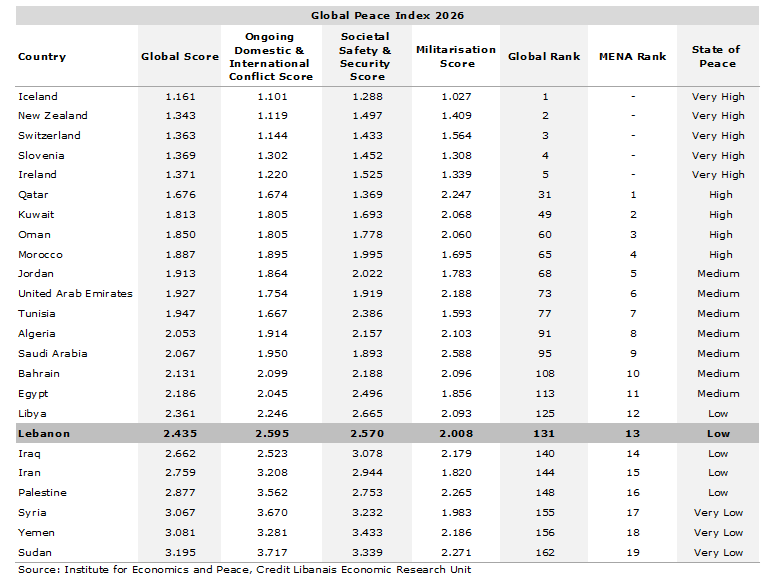
The Institute for Economics and Peace (IEP) published its 20th edition of the Global Peace Index (GPI) in which it ranked 163 independent nations and territories based on their level of peacefulness while providing an analysis on peace developments across the globe. In details, the index is calculated based on 23 quantitative and qualitative indicators and evaluates the state of peace according to three main pillars, namely the level of societal safety and security, the extent of ongoing domestic and international conflict, and the degree of militarization. In this vein, the report revealed that global peace has deteriorated for the fifteenth time during the past eighteen years, and for the twelfth year on a row. According to the report, 62 nations witnessed some progress in their GPI scores, while 99 countries saw a deterioration. More particularly, Iceland emerged as the most peaceful country in the world, a position it has held since 2008, with a global score of 1.161 and a state of peace labeled as “very high”. New Zealand ranked second in the 2026 GPI (score: 1.343; state of peace: very high), followed by Switzerland (score: 1.363; state of peace: very high), Slovenia (score: 1.369; state of peace: very high), and Ireland (score: 1.371; state of peace: very high), only to name a few. From another standpoint, the IEP estimated the economic impact of violence on the global economy in 2025 at $21.8 trillion in purchasing power parity (PPP) terms (up from $20.0 trillion in 2024), the equivalent of 10.5% of world GDP and $2,657 per capita. It is worth noting that the economic impact of violence takes into account the direct and indirect costs of violence as well as an economic multiplier applied to direct costs.
On a regional basis, the report indicated that the Middle East and North Africa (MENA) region remained the world’s least peaceful region for the eleventh year in a row, with its Global Peace Index score regressing in 2025 by around 0.50% in the 2026 report. According to the report, Qatar emerged as the most peaceful country in the region and occupied the 31st place internationally (score: 1.676; state of peace: high), followed by Kuwait (global rank: 49; score: 1.813; state of peace: high), Oman (global rank: 60; score: 1.850; state of peace: high), and Morocco (global rank: 65; score: 1.887; state of peace: high), among others.
Locally, Lebanon ranked 131st in the world and 13th in the MENA region in the 2026 Global Peace Index with a global score of 2.435 (bettering last year’s score of 2.674) and a “low” state of peace classification, with the improvement in score mainly being attributed to the November 2024 ceasefire agreement.
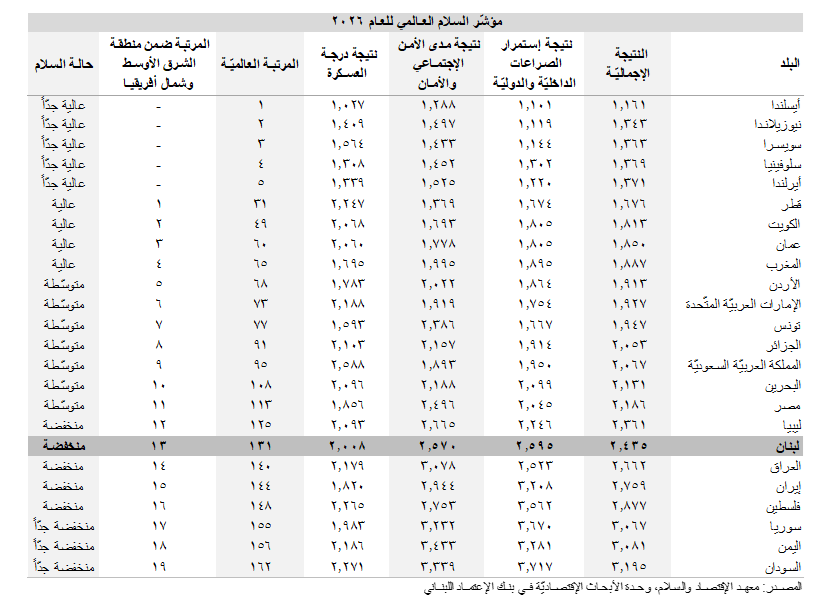
أَصدَرَ معهد الإقتصاد والسلام تقريره العشرين من مؤشِّر السلام العالمي والذي يصنِّف من خلاله 163 دولة وإقليم مستقلّ وفقاً لمستويات السلام لديها، كما ويقدِّم تحليلاً حول التطوّرات العالميّة في موضوع السلام. في التفاصيل، يتمّ إحتساب المؤشِّر إستناداً إلى 23 عنصراً كمّيّاً ونوعيّاً تحت مظلّة ثلاثة عوامل رئيسيّة هي مستوى الأمن الإجتماعي والأمان، ومدى إستمرار الصراعات الداخليّة والدوليّة، ودرجة العسكرة. في هذا الإطار، كَشَفَ التقرير أنّ السلام العالمي قد تراجع للمرّة الخامسة عشر خلال فترة الثمانية عشر عامّاً الماضية كما وللمرّة الثانية عشر على التوالي. وبحسب التقرير، شهدت 62 دولة تحسّناً في مؤشِّر السلام العالمي، في حين سجَّلت 99 دولة تراجعاً. وقد برزت أيسلندا كالدولة الأكثر تنعّماً بالسلام في العالم، وهو مركز لا تزال تحتلّه منذ العام 2008، محقّقةً نتيجة 1.161 في المؤشّر وحالة سلام "عالية جدّاً"، تلتها نيوزيلندا (النتيجة: 1.343؛ حالة السلام: عالية جدّاً)، وسويسرا (النتيجة: 1.363؛ حالة السلام: عالية جدّاً)، وسلوفينيا (النتيجة: 1.369، حالة السلام : عالية جدّاً)، وإيرلندا (النتيجة: 1.371؛ حالة سلام: عالية جدّاً)، للذكر لا الحصر. من منظارٍ آخر، قَدَّرَ معهد الإقتصاد والسلام الأثر الإقتصادي للعنف على الإقتصاد العالمي في العام 2025 ب21.8 تريليون د.أ. (على أساس تعادل القوة الشرائية (Purchasing Power Parity)) مقارنةً مع 20.0 تريليون د.أ. في العام 2024، أي ما يشكّل نسبة 10.5% من الناتج المحلّي الإجمالي العالمي أو 2،657 د.أ. للفرد الواحد. ويجدر الذكر بأنّ الأثر الإقتصادي للعنف يتضمّن الكلفة المباشرة وغير المباشرة للعنف كما ومضاعف إقتصادي يطبّق على الكلفة المباشرة.
على صعيدٍ إقليميٍّ، أشار التقرير إلى أنّ منطقة الشرق الأوسط وشمال أفريقيا قد بقيت الأقلّ سلماً في العالم للعام الحادي عشر على التوالي، مسجّلةً تراجعاً بحوالي 0.50% في نتيجتها في مؤشّر السلام في العام 2026 وبحسب التقرير، جاءت قطر كالدولة الأكثر سلماً في المنطقة محتلّة المرتبة 31 عالميّاً بنتيجة 1.676 وحالة سلام عالية، تبعتها الكويت (المركز العالمي: 49؛ النتيجة: 1.813؛ حالة سلام: عالية)، وعمان (المركز العالمي: 60؛ النتيجة: 1.850؛ حالة سلام: عالية)، والمغرب (المركز العالمي: 65؛ النتيجة: 1.887؛ حالة سلام: عالية).
محلّيّاً، إحتلّ لبنان المرتبة 131 في العالم والمرتبة 13 في منطقة الشرق الأوسط وشمال أفريقيا في مؤشِّر السلام العالمي للعام 2026 بنتيجة 2.435 (متفوّقاً على نتيجة ال2.674 المسجّلة في العام 2025) وحالة سلام "منخفضة" وهو ما عزاه التقرير إلى إتّفاق وقف إطلاق النار الذي تمّ توقيعه في تشرين الثاني 2024.