




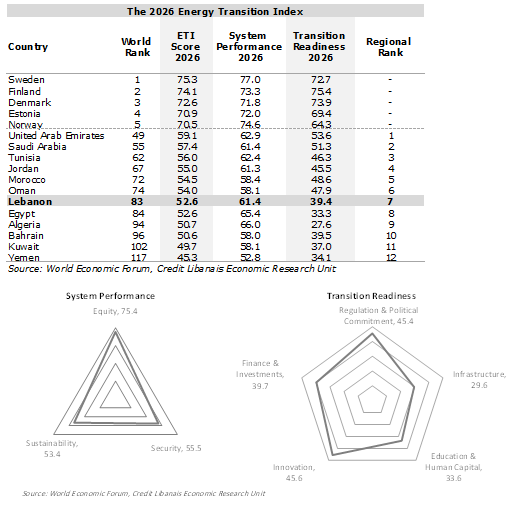
The World Economic Forum in collaboration with Accenture recently released its year 2026 edition of the Energy Transition Index “Energy Transition Index” (ETI). The ETI mainly aims at measuring the performance of energy systems and readiness for energy transition across 120 countries around the world. According to the report, 67 out of 120 countries managed to improve their scores in 2026, noting that the share of countries that managed to improve their scores across all three energy dimensions stood at 24%, indicating that the majority of countries failed to progress evenly in all three dimensions. The report stated that for the first time in over a decade, the supporting conditions that fuel future progress, policy, finance, innovation and infrastructure have deteriorated. The report commented however that global energy investments have attained $3.3 trillion in 2025, with renewables and nuclear energy generating 42% of electricity, and renewable energy capacity has expanded by around 800 gigawatts (GW). In this respect, the report stated that said improvements face mounting constraints, namely grid congestion, permits delays, underinvestment, and trade restrictions in late 2025 and early 2026 (affecting some $2.6 trillion of global commerce). In addition, the report mentioned that the disruption of energy flows through the Strait of Hormuz in 2026 shed light on the vulnerabilities in the global energy sector and has triggered one of the largest energy shocks since 2022. As per the report, the ETI is divided into two sub-indices, namely “System Performance” (60% weight) and “Transition Readiness” (40% weight). The system performance sub-index is broken down into three factors (equity, security, and sustainability) while the transition readiness sub-index is divided into five factors (regulation & political commitment, infrastructure, education & human capital, innovation, and finance & investments). On the rankings front, Sweden came in first in the 2026 ETI with a score of 75.3, scoring 77.0 in system performance and 72.7 in transition readiness. Finland occupied the second place in the world with an ETI score of 74.1 (73.3 in system performance and 75.4 in transition readiness), and was followed by Denmark with a score of 72.6 (71.8 in system performance and 73.9 in transition readiness), Estonia with a score of 70.9 (72.0 in system performance and 69.4 in transition readiness) and Norway with a score of 70.5 (74.6 in system performance and 64.3 in transition readiness). The United Arab Emirates ranked first in the region and 49th in the world with an ETI score of 59.1 (62.9 in system performance, 53.6 in transition readiness), followed by Saudi Arabia which ranked 55th globally with a score of 57.4 (61.4 in system performance and 51.3 in transition readiness) and Tunisia which ranked 62nd globally with a score of 56.0 (62.4 in system performance and 46.3 in transition readiness) only to name a few. Locally, Lebanon positioned 83rd in the world and 7th in the region in the 2026 ETI index with a score of 52.6, compared to a score of 52.9 in the 2025 ETI index. The country scored 61.4 in the system performance sub-index and 39.4 in the transition readiness sub-index, compared to scores of 60.5 and 41.5 respectively in the 2025 ETI. The performance of Lebanon in all three components of the system performance sub-index and five components of the transition readiness sub-index are sketched in the below diagrams:
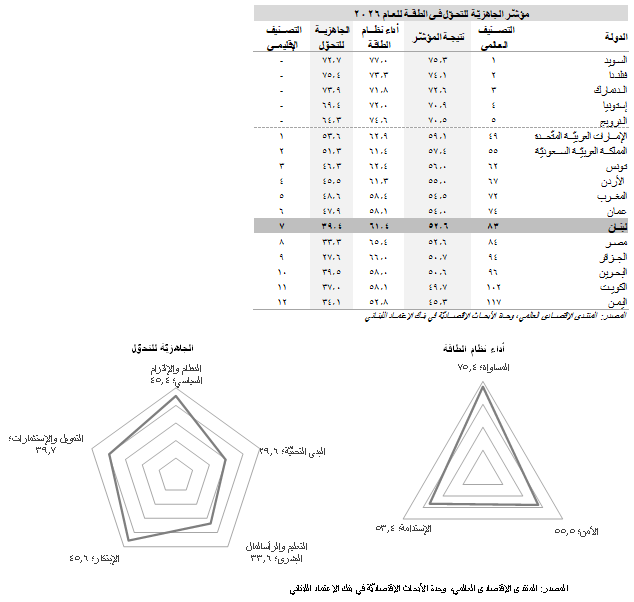
أصدر المنتدى الإقتصادي العالمي بالتعاون مع مؤسّسة أكسنتور نسخة العام 2026 من مؤشّر الجاهزيّة للتحوّل في الطاقة والذي يهدف إلى قياس أداء أنظمة الطاقة والجاهزيّة للتحوّل في الطاقة في 120 بلد حول العالم. وبحسب التقرير، فقد تمكّنت 67 دولة من أصل 120 من تحسين نتيجتها في العام 2026، علماً أنّ حصّة البلدان التي نجحت بتحسين نتائجها في أبعاد الطاقة الثلاث هي 24%، الأمر الذي يدلّ على أنّ غالبيّة البلدان لم تنجح بتحسين نتائجها في الأبعاد الثلاث بشكلٍ متساوٍ. وقد أشار التقرير أنّه للمرّة الأولى منذ أكثر من عقد، تراجعت الشروط المساندة التي تغذّي التقدّم المستقبلي والسياسات والماليّة والإبتكار والبنى التحتيّة. وقد علّق التقرير أنّ الإستثمارات العالميّة في الطاقة قد بلغت 3.3 ترليون د.أ. في العام 2025 حيث أنّ الطاقة المتجدّدة والطاقة النوويّة تنتج 42% من الكهرباء، في حين أنّ قدرة إنتاج الطاقة المتجدّدة قد زادت بأكثر من 800 جيجاواط. في هذا الإطار، أشار التقرير إلى أنّ هذه التحسّنات تواجه تحدّيات جمّة كالزحمة على الشبكات وتأجيل الرخص ونقص الإستثمار والقيود التجاريّة في أواخر العام 2025 وأوائل العام 2026 (والتي تأثّر على 2.6 ترليون د.أ. من التجارة العالميّة). بالإضافة إلى ذلك، ذكر التقرير أنّ إنقطاع تدفّقات الطاقة عبر مضيق هرمز خلال العام 2026 قد سلّط الضوء على نقاط الضعف في قطاع الطاقة العالمي وتسبّب بإحدى أكبر صدمات الطاقة منذ العام 2022. ويُقسِّم التقرير مؤشّر الجاهزيّة للتحوّل في الطاقة إلى مؤشّرين ثانويّين ألا وهما "أداء نظام الطاقة" (تثقيل 60%) و"الجاهزيّة للتحوّل" (تثقيل 40%). ويقسّم مؤشّر نظام الطاقة أيضاً إلى ثلاثة عوامل (المساواة والأمن والإستدامة) في حين أنّ مؤشّر الجاهزيّة للتحوّل يقسّم إلى خمسة عوامل (النظام والإلتزام السياسي، والبنى التحتيّة، والتعليم والرأسالمال البشري، والإبتكار، والتمويل والإستثمارات). أمّا لناحية التصنيف، فقد إحتلّت السويد المرتبة الأولى في مؤشّر الجاهزيّة للتحوّل في الطاقة للعام 2026 بنتيجة 75.3 مسجّلةً نتيجة 77.0 في أداء نظام الطاقة و72.7 في الجاهزيّة للتحوّل. وقد أتت فنلندا في المرتبة الثانية بنتيجة 74.1 (نتيجة 73.3 في أداء نظام الطاقة و75.4 في الجاهزيّة للتحوّل) تبعتها كلّ من الدنمارك بنتيجة 72.6 (نتيجة 71.8 في أداء نظام الطاقة و73.9 في الجاهزيّة للتحوّل) وإستونيا بنتيجة 70.9 (نتيجة 72.0 في أداء نظام الطاقة و69.4 في الجاهزيّة للتحوّل) والنرويج بنتيجة 70.5 (نتيجة 74.6 في أداء نظام الطاقة و64.3 في الجاهزيّة للتحوّل). إقليميّاً، حلّت الإمارات العربيّة المتّحدة في المرتبة الأولى وفي المرتبة ال49 عالميّاً بنتيجة 59.1 (نتيجة 62.9 في أداء نظام الطاقة و53.6 في الجاهزيّة للتحوّل) متبوعةً من المملكة العربيّة السعوديّة التي إحتلّت المرتبة ال55 عالميّاً بنتيجة 57.4 (نتيجة 61.4 في أداء نظام الطاقة و51.3 في الجاهزيّة للتحوّل) وتونس التي إحتلّت المرتبة ال62 عالميّاً بنتيجة 56.0 (نتيجة 62.4 في أداء نظام الطاقة و46.3 في الجاهزيّة للتحوّل) للذكر لا الحصر. محليّاً، أتى لبنان في المرتبة 83 في العالم وفي المركز ال7 في المنطقة في مؤشّر الجاهزيّة للتحوّل في الطاقة للعام 2026 بنتيجة 52.6، مقارنةً بنتيجة 52.9 في مؤشّر العام 2025. بالتفاصيل، سجّل لبنان نتيجة 61.4 في أداء نظام الطاقة و39.4 في جاهزيّة التحوّل في مؤشّر العام 2026، مقارنةً مع نتيجة 60.5 لناحية أداء نظام الطاقة و41.5 لناحية الجاهزيّة للتحوّل في مؤشّر العام 2025. تظهر البيانات التالية أداء لبنان في المحاور الثلاث المتعلّقة بأداء نظام الطاقة والعناصر الخمس المتعلّقة بجاهزيّة تحوّل الطاقة: