




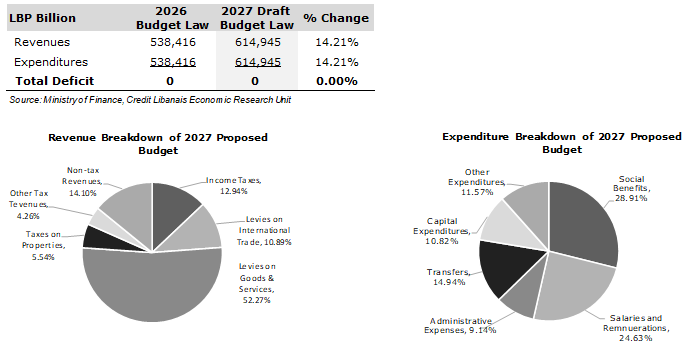
The Minister of Finance Mr. Yassin Jaber recently submitted to the government a balanced draft budget law for the year 2027 targeting revenues and expenditures of LBP 614.95 trillion (around $6.87 billion) each, up by 14.21% from year 2026’s budget law figures of LBP 538.42 trillion (around $6.02 billion). It is worth noting that in accordance with the practice established in recent years, the 2027 budget law does not include an advance to Eléctricité du Liban (EDL) after the latter revised its tariffs to stand above production costs. The draft budget suggests a high contribution from tax revenues of LBP 528.22 trillion, representing 85.90% of total revenues, with non-tax revenues (LBP 86.72 trillion) expected to represent 14.10% of target revenues. Delving into details, levies on goods and services (LBP 321.43 trillion vs LBP 255.79 trillion in the 2026 budget law) are budgeted to be the major contributor (52.27%) to total revenues, with levies on international trade (LBP 66.94 trillion vs LBP 73.91 trillion in the 2026 budget law) and taxes on properties (LBP 34.05 trillion vs LBP 36.01 trillion in the 2026 budget law) accounting for 10.89% and 5.54% of total revenues respectively. It is worth noting, in this perspective, that non-tax revenues mainly represent revenues from state owned enterprises such as Casino du Liban, Lebanese ports, the Rafik Hariri Beirut International Airport and the telecom sector among others. The draft law introduced a new measure through which it provides Lebanese residents a six-month period from the date of the publication of the draft law to declare and pay the tax associated with income/revenues generated abroad that had not previously been declared to avoid incurring penalties. In addition, the draft budget law revised the taxes on capital gains stemming from the disposal of realty subjecting the seller to a 10% tax in the case of a natural person that is not subject to income tax and to a 15% for any other person, noting that a 1% tax is applied on capital gains arising from the disposal of a real estate property owned prior to July 1, 2023. More specifically, and in order to calculate taxable gains, 8% of the gain is deducted for each complete year between owning and disposing of the property, bearing in mind that the gain becomes exempt from taxes once the property has been held for 12 complete years or more. In the same regard, the sale must be declared and the taxes paid within two months of the disposal, noting that the provisions of said measure become effective starting January 1, 2027. Concerning holding companies, the 2027 draft budget law commented that their capital may be denominated in either US Dollars or Euros, noting that their financial accounts must be prepared in the same foreign currency, the same thing applies for their tax declarations. In addition, the draft law stipulates that holding companies and offshore companies will be subject to an annual tax of LBP 200 million (up from LBP 50 million previously), or its equivalent in US Dollars or Euros, with the provisions of this measure becoming functional starting the year 2027. Also on the revenues front, the fee associated with the issuance of a new identity card was increased to LBP 1 million from LBP 5,000 previously. On the expenditures front, social benefits are expected to account for over one-quarter (28.91%; LBP 177,773 billion) of total budgeted expenditures, followed by salaries & remunerations (24.63%; LBP 151,455 billion) and transfers (14.94%; LBP 91,846 billion). Other significant expenditure items include capital expenditures (10.82%; LBP 66,518 billion) mainly in the form of governmental expropriations, and administrative expenses (9.14%; LBP 56,234 billion). Delving further into details, the 2027 draft budget law has allocated some LBP 95,174 billion to retirement pensions & end of service indemnities, the equivalent of 15.48% of total expenditures. The draft budget allocated some LBP 22,103 billion (3.59% of total expenditures) to road works, around LBP 37,235 billion (6.06% of total expenditures) to hospitalization services (including some LBP 31,343 billion for private-sector hospitalization), and circa LBP 59,314 billion (9.65% of total expenditures) to education (of which some 21,027 billion for secondary education, LBP 16,753 billion for basic education, and LBP 15,114 billion for university education).
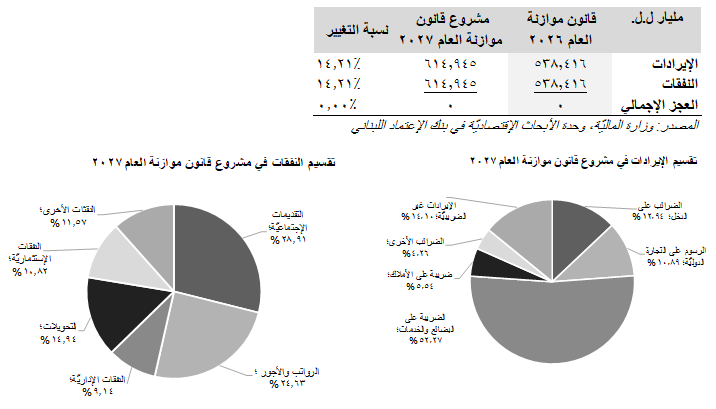
أرسل وزير المال السيّد ياسين جابر مشروع قانون موازنة العام 2027 يظهر توازن بين الإيرادات الحكوميّة والنفقات عند 614.95 تريليون ل.ل. (حوالي 6.87 مليار د.أ.) لكلٍّ منها أيّ بزيادة نسبتها 14.21% عن أرقام قانون موازنة العام 2026 والذي كان يستهدف إيرادات ونفقات حكوميّة بقيمة 538.42 تريليون ل.ل. (حوالي 6.02 مليار د.أ.). ويجدر الذكر في هذا السياق بأنّ مشروع قانون الموازنة الحالي (وأسوةً بمشاريع قوانين الموازنة مؤخّراً) لا يلحظ سلفة لمصلحة مؤسّسة كهرباء لبنان وذلك بعد قيام هذه الأخيرة بتعديل تعرفتها لتفوق كلفة إنتاج الطاقة. وقد لحظ مشروع الموازنة مساهمة كبيرة (85.90%) للإيرادات الضريبيّة عند مستوى 528.22 تريليون ل.ل. فيما يستهدف إيرادات غير ضريبيّة بقيمة 86.72 تريليون ل.ل. (14.10% من إجمالي الإيرادات الحكوميّة). بالتفاصيل، تتوقّع الموازنة أن تشكّل الضرائب على السلع والخدمات (321.43 تريليون ل.ل. مقابل 255.79 تريليون ل.ل. في قانون موازنة العام 2026) الحصّة الأكبر 52.27% من إجمالي الإيرادات الحكوميّة فيما ترتقب أن تشكّل الرسوم على التجارة الدوليّة (66.94 تريليون ل.ل. مقابل 73.91 تريليون ل.ل. في قانون موازنة العام 2026) 10.89% من إجمالي الإيرادات والضريبة على الأملاك (34.05 تريليون ل.ل. مقابل 36.01 تريليون ل.ل. في قانون موازنة العام 2026) 5.54% من إجمالي الإيرادات. ومن الجدير بالذكر في هذا السياق، بأنّ الإيرادات غير الضريبيّة تشمل إيرادات المؤسّسات المملوكة من الدولة مثل كازينو لبنان والموانئ ومطار رفيق الحريري الدولي وقطاع الإتّصالات وغيرها. وقد أدخل مشروع القانون بنداً جديداً يمنح المقيمين في لبنان مهلة ستّة أشهر من تاريخ نشر مشروع القانون للتصريح عن وتسديد الضريبة على الإيرادات على اختلاف أنواعها التي حصلوا عليها من الخارج والتي لم يصرّحوا عنها دون أن تفرض أيّ غرامة تحقّق أو تحصيل. بالإضافة إلى ذلك، عدّل مشروع قانون الموازنة ضريبة أرباح التفرّغ عن العقارات بحيث أخضع المتفرّغ لضريبة بنسبة 10% إذا كان شخصاً طبيعياً غير خاضع لضريبة الدخل، وبنسبة 15% لباقي الأشخاص الطبيعيّين والمعنويّين، علماً أن أرباح التفرّغ عن العقارات المملوكة قبل 1 تمّوز 2023 تخضع لضريبة بنسبة 1%. بالتفاصيل، ومن أجل احتساب ربح التفرّغ الخاضع للضريبة، تنزّل عن كلّ سنة كاملة تفصل بين تاريخ حيازة العقار وتاريخ التفرّغ عنه نسبة 8% من ربح التفرّغ، مع الإشارة إلى أنّ الربح يُعفى من الضريبة عند التفرّغ عن العقار إذا كان المتفرّغ قد استمرّ في حيازته لمدة 12 سنة كاملة أو أكثر. وبحسب مشروع القانون، يتوجّب أن يصرّح المتفرّغ عن عمليّة التفرّغ الخاضعة للضريبة وتسديد الضرائب المستحقة خلال مهلة شهرين من تاريخ التفرّغ، علماً أن أحكام هذا النصّ تصبح نافذة اعتباراً من 1 كانون الثاني 2027. وفيما يتعلق بشركات الهولدنغ، أشار مشروع قانون موازنة العام 2027 أنّه يمكن أن يكون رأسمالها بالدولار الأميركي أو باليورو، على أن تمسك حساباتها الماليّة بالعملة الأجنبية نفسها، وينطبق الأمر ذاته على تصاريحها الضريبيّة. بالإضافة إلى ذلك، ينص مشروع القانون على إخضاع شركات الهولدنغ وشركات الأوف شور لضريبة سنويّة مقطوعة قدرها 200 مليون ل.ل.، مقارنةً بـ50 مليون ل.ل. سابقاً، أو ما يعادلها بالدولار الأميركي أو باليورو، على أن تصبح أحكام هذا النصّ نافذة اعتباراً من العام 2027. وفيما يتعلق بالرسوم الأخرى، فقد تم رفع رسوم إصدار بطاقة هويّة إلى مليون ل.ل. بدلاً من 5000 ل.ل. أمّا لجهة النفقات الحكوميّة، يتوقّع مشروع الموازنة أن تشكّل التقديمات الاجتماعيّة أكثر من ربع (28.91%؛ 177،773 مليار ل.ل.) النفقات الحكوميّة المتوقّعة تتبعها الرواتب وملحقاتها (24.63%؛ 151،455 مليار ل.ل.) والتحويلات (14.94%؛ 91،846 مليار ل.ل.) والنفقات الاستثماريّة (10.82%؛ 66،518 مليار ل.ل.) والأعباء الإداريّة (9.14%؛ 56،234 مليار ل.ل.). بالتفاصيل، خصّص مشروع قانون موازنة العام 2027 نحو 95,174 مليار ل.ل. لمعاشات التقاعد وتعويضات نهاية الخدمة، أيّ ما يعادل 15.48% من إجمالي النفقات ونحو 22,103 مليار ل.ل. (أيّ 3.59% من إجمالي النفقات) لأشغال الطرق وحوالي 37,235 مليار ل.ل. (أيّ 6.06% من إجمالي النفقات) لخدمات الاستشفاء (من ضمنها نحو 31,343 مليار ل.ل. للاستشفاء في القطاع الخاص) ونحو 59,314 مليار ل.ل. (أيّ 9.65% من إجمالي النفقات) للتعليم (منها نحو 21,027 مليار ل.ل. للتعليم الثانويّ و16,753 مليار ل.ل. للتعليم الأساسي و15,114 مليار ل.ل. للتعليم الجامعي).