




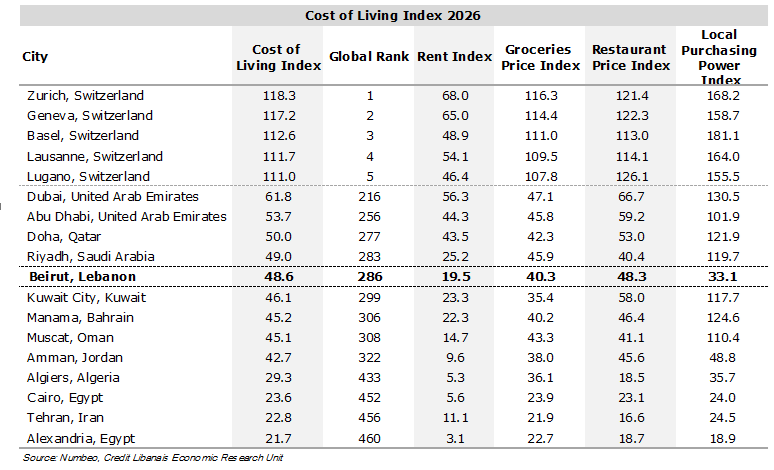
Numbeo.com, a global statistics website, recently released its global cost of living index (CoLI) in which it compares cities worldwide based on their scores in the index when benchmarked to New York City. It also provides the values of four other indices namely the Rent Index, the Groceries Price Index, the Restaurant Price Index, and the Local Purchasing Power Index for each city, always when benchmarked to the city of New York. According to Numbeo’s latest statistics, Swiss cities emerged as the most expensive cities in the world, occupying the top 5 positions, with Zurich ranking first with a Cost of Living index score of 118.3 followed by Geneva (score of 117.2), Basel (score of 112.6), Lausanne (score of 111.7) and Lugano (score of 111.0). Zurich’s CoLI value of 118.3 implies that prices in Zurich are 18.3% more expensive than those in New York City (which ranked 7th globally). Regionally, Dubai, was the most expensive Arab city on the 2026 Numbeo list with a CoLI value of 61.8 (ranking 216th globally), followed by Abu Dhabi (CoLI value of 53.7 and global rank of 256) and Doha (CoLI value of 50.0 and global rank of 277). Beirut was the 5th most expensive Arab city on the 2026 Numbeo list with a CoLI value of 48.6, ranking 286th in the world.Therefore, prices in Beirut are 51.4% less expensive than those in New York City. Beirut also scored 19.5 in the Rent Price Index (implying that rent prices in Beirut are 80.5% less expensive than those in New York City), 40.3 in the Groceries Price Index (therefore prices of grocery items in Beirut are 59.7% lower than those in New York City), 48.3 in the Restaurant Price Index (implying restaurant prices in Beirut are 51.7% cheaper than in New York), and 33.1 in the Local Purchasing Power Index (meaning that the local purchasing power is 66.9% lower than that in New York City).
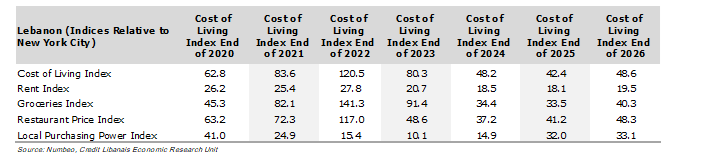
The historical evolution of the CoLI shows that prices in Beirut have generally been increasing over the period extending between 2020 and 2022 before starting their downturn till the year 2025. The hike in the CoLI values between the years 2020 and 2022 owes to the hyperinflationary environment which followed the drastic devaluation of the Lebanese pound against the US dollar as a result of the local financial crisis that started in late 2019. The CoLI, however, increased for the year 2026 to 48.6 up from 42.4 in the index of 2025 amid the increase in the value of all covered indices.
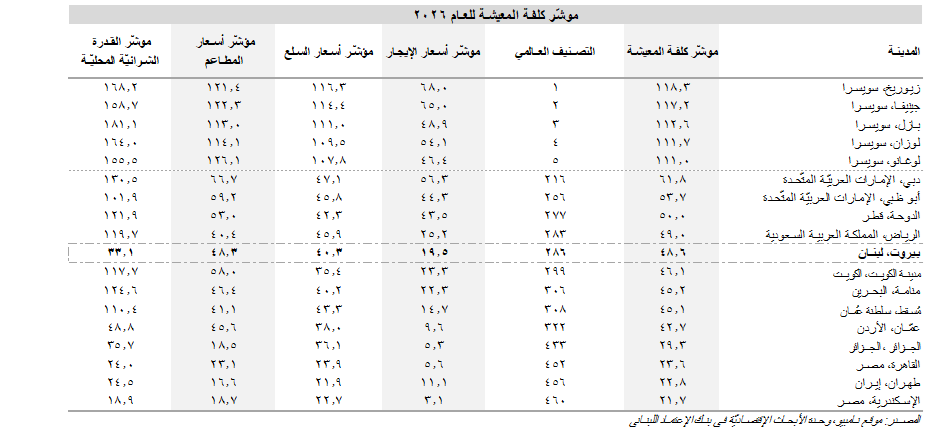
أصدر موقع نامبيو للإحصاءات مؤخّراً مؤشّر كلفة المعيشة العالمي، والذي يصنّف من خلاله المدن حول العالم بحسب نتيجة المؤشّر المذكور في كلٍّ منها عند مقارنته بأرقام مدينة نيويورك، إضافةً إلى نشره لإحصاءات عن أربعة مؤشّراتٍ أخرى ألا وهي موشّر أسعار الإيجار ومؤشّر أسعار السلع ومؤشّر أسعار المطاعم ومؤشّر القدرة الشرائيّة المحليّة في تلك المدن. وقد أظهرت الإحصاءات هيمنة للمدن السويسريّة والتي إحتلّت المراتب الخمس الأول مع حلول مدينة زوريخ في المرتبة الأولى عالميّاً بنتيجة 118.3 في المؤشّر (أي أنّ الأسعار في زيوريخ هي أغلى بنسبة 18.3% من الأسعار في مدينة نيويورك والتي إحتلّت المرتبة السابعة) تلتها كلّ من جينيف (نتيجة 117.2 في المؤشر) وبازل (نتيجة 112.6 في المؤشّر) ولوزان (نتيجة 111.7 في المؤشّر) ولوغانو (نتيجة 111.0 في المؤشّر). على صعيدٍ إقليميٍّ، برزت مدينة دبي كأغلى مدينة عربيّة عند مقارنة مستوى الأسعار فيها بالأسعار في مدينة نيويورك بحيث بلغ مؤشّر كلفة المعيشة فيها 61.8 (المركز العالمي: 216)، تبعتها مدينة أبو ظبي (النتيجة: 53.7 والمرتبة 256 عالميّاً)، والدوحة (النتيجة 50.0 والمرتبة 277 عالميّاً). وقد برزت بيروت كخامس أغلى مدينة عربيّة عند مقارنة مستوى الأسعار فيها بالأسعار في مدينة نيويورك بحيث بلغ مؤشّر كلفة المعيشة فيها 48.6 لتأتي في المرتبة ال286 في العالم. بالتالي، فإنَّ الأسعار في بيروت هي 51.4% أقلّ كلفة من تلك في مدينة نيويورك. كذلك سجّلت بيروت نتيجة 19.5 في مؤشّر أسعار الإيجار (ما يعني أنّ أسعار الإيجار في مدينة بيروت هي أقلّ كلفة من تلك في مدينة نيويورك بنسبة 80.5%) و40.3 في مؤشّر أسعار السلع (أيّ أنّ أسعار السلع في مدينة بيروت أقلّ كلفة بنسبة 59.7% من تلك في مدينة نيويورك) و48.3 في مؤشّر أسعار المطاعم (ما يعني أنّ أسعار المطاعم في مدينة بيروت هي أقلّ كلفة بنسبة 51.7% ممّا هي عليه في مدينة نيويورك) و33.1 في مؤشّر القدرة الشرائيّة (أيّ أنّ القدرة الشرائيّة في مدينة بيروت هي أقلّ بنسبة 66.9% من تلك في مدينة نيويورك).
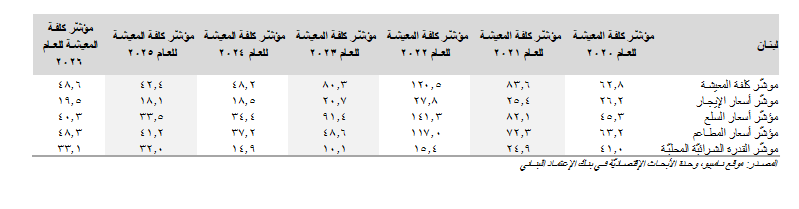
من ناحية أُخرى، يُظهر التطوّر التاريخي لمؤشّر كلفة المعيشة في بيروت أنَّ الأسعار في لبنان قد زادت بين الأعوام 2020 و2022 قبل أن تعود وتنخفض في الأعوام الثلاث اللاحقة. يمكن تعليل الإرتفاع في مؤشّر كلفة المعيشة في بيروت بين الأعوام 2020 و2022 بالأزمة الإقتصاديّة والماليّة التي تمرّ بها البلاد وما خلّفته من غلاءٍ كبير في المعيشة جرّاء تدهور سعر صرف الليرة مقابل الدولار الأميركي. ولكنّ المؤشّر قد عاد وإرتفع في العام 2026 إلى 48.6 مقارنةً مع 42.4 في مؤشّر العام 2025 بسبب الزيادة المشهودة في جميع المؤشّرات المشمولة.