




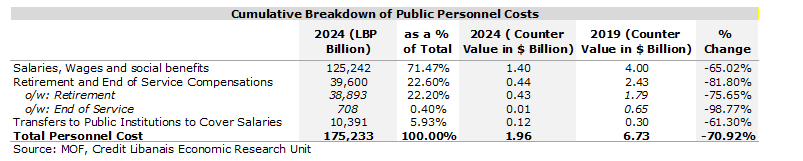
According to the Ministry of Finance’s recently published public finance monitor, public personnel costs reached LBP 175.23 trillion (~$1.96 billion) in 2024 compared to a pre-crisis level of ~$6.73 billion in 2019. This drop can be attributed to the frantic depreciation in the value of the Lebanese pound, noting that the government has tried to alleviate the burden of the crisis by granting public sector employees temporary additional payments (not included in the basic salary) under the label of social assistance. In details, the number of these additional payments most recently attained four starting the month of December 2024 and accordingly are not fully reflected in the aggregate cost for the year 2024. Personnel costs can be broken down into three main constituents, namely “salaries, wages, and social benefits” (encompassing basic salaries, indemnities, allowances, and others), “retirement and end of service compensations”, and “transfers to public institutions to cover salaries”.
Salaries, wages, and social benefits, which constituted the bulk (71.47%) of public servants’ costs attained LBP 125.24 trillion in 2024 ($1.40 billion) versus a pre-crisis level of ~$4.00 billion in 2019 while retirement and end of service compensations, which accounted for 22.60% of total public servants’ costs, leveled at LBP 39.60 trillion ($442 million vs a pre-crisis level of $2.43 billion). Transfers to public institutions to cover salaries (5.93% of total personnel costs) reached LBP 10.39 trillion (~$116 million) in 2024 compared to a pre-crisis level of $300 million in 2019. It is worth noting that total personnel costs constituted about 56.54% of the government’s primary expenditures in 2024 compared to 59.28% in 2019.
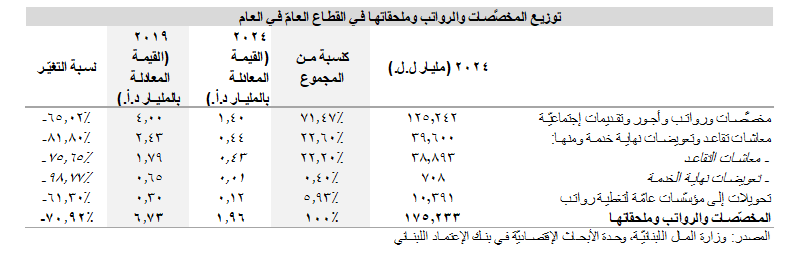
بحسب " مرصد الماليّة العامّة" للعام 2024 الذي أصدَرَته وزارة المال اللبنانيّة مؤخَّراً بلغ إجمالي الإنفاق على المخصّصات والرواتب وملحقاتها في القطاع العام 175.23 تريليون ل.ل. (نحو 1.96 مليار د.أ.) في العام 2024، مقارنة بمستوى 6.73 مليار د.أ. ما قبل الأزمة في العام 2019. ويعود هذا التراجع الحاد إلى الإنهيار المتسارع في سعر صرف الليرة اللبنانيّة، وقد حاولت الحكومة تخفيف وطأة الأزمة عبر منح موظفي القطاع العام زيادات مؤقّتة (لا تُحتسب ضمن الراتب الأساسي) تحت مسمّى "مساعدات اجتماعية". وقد وصل عدد هذه الزيادات مؤخّراً إلى أربعة رواتب إضافيّة بدءاً من شهر كانون الأول 2024، وبالتالي لم تنعكس قيمتها بالكامل في التكلفة الإجماليّة لعام 2024. يمكِن تجزئة هذا الإنفاق إلى ثلاثة عناصر رئيسيّة ألا وهي "مخصَّصات ورواتب وأجور وتقديمات إجتماعيّة"، "معاشات تقاعد وتعويضات نهاية خدمة"، و"تحويلات إلى مؤسَّساتٍ عامّة لتغطية رواتب".
وقد بلغت المخصَّصات والرواتب وملحقاتها والتي شكلّت الجزء الأكبر (71.47%) من تكاليف موظّفي القطاع العام 125.24 تريليون ل.ل. (1.40 مليار د.أ.) في العام 2024 مقارنةً بمستوى ما قبل الأزمة البالغ حوالي 4.00 مليار د.أ. في العام 2019، في حين بلغت معاشات التقاعد وتعويضات نهاية الخدمة والتي شكلّت 22.60% من إجمالي كلفة موظّفي القطاع العام، 39.60 تريليون ل.ل. (442 مليون د.أ.) مقابل 2.43 مليار د.أ. في العام 2019. أما بالنسبة للتحويلات إلى المؤسّسات العامّة لتغطية الرواتب (5.93% من إجمالي تكاليف موظّفي القطاع العام) فقد بلغت هذه الأخيرة 10.39 تريليون ليرة لبنانية (حوالي 116 مليون د.أ.) في العام 2024 مقارنةً بمستوى 300 مليون د.أ. في العام 2019. يجدر الذكر أنّ الإنفاق على المخصّصات والرواتب وملحقاتها قد شَكَّلَ 56.54% من النفقات الحكوميّة الأوليّة في العام 2024 مقابل نسبة 59.28% في العام 2019.