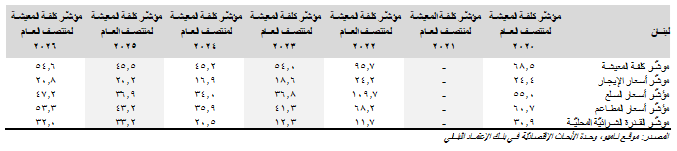





Numbeo.com, a global statistics website, recently released its global cost of living index (CoLI) in which it compares cities worldwide based on their scores in the index when benchmarked to New York City. It also provides the values of four other indices namely the Rent Index, the Groceries Price Index, the Restaurant Price Index, and the Local Purchasing Power Index for each city, always when benchmarked to the city of New York. According to Numbeo’s latest statistics, 4 Swiss cities emerged among the most expensive cities in the world, occupying 4 of the top 5 positions, with Zurich ranking first with a Cost of Living index score of 123.1, Lucerne coming in third (score of 112.7), Basel coming in fourth (score of 111.9), and Geneva occupying the fifth place (score of 111.3). George Town, Cayman Islands held the second place in the index with a CoLI score of 116.5. Zurich’s CoLI value of 123.1 implies that prices in Zurich are 23.1% more expensive than those in New York City (which ranked 12th globally). Regionally, Dubai was the most expensive Arab city on the Mid-2026 Numbeo’s list with a CoLI value of 62.5 (ranking 232nd in the world), followed by Abu Dhabi, UAE (CoLI value of 55.1 and global rank of 283) and Beirut (CoLI value of 54.6 and global rank of 287). Therefore, prices in Beirut are 45.4% less expensive than those in New York City. Beirut also scored 20.8 in the Rent Price Index (implying that rent prices in Beirut are 79.2% less expensive than those in New York City), 47.2 in the Groceries Price Index (therefore prices of grocery items in Beirut are 52.8% lower than those in New York City), 53.3 in the Restaurant Price Index (implying restaurant prices in Beirut are 46.7% less expensive than in New York), and 32.00 in the Local Purchasing Power Index (meaning that the local purchasing power is 68.0% lower than that in New York City).
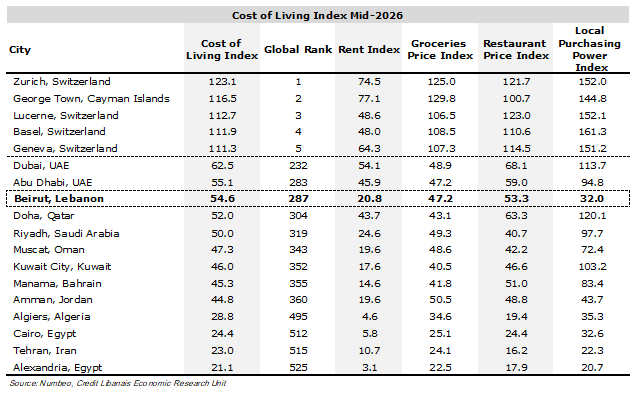
The historical evolution of the CoLI shows that prices in Beirut have generally been increasing over the period extending between Mid-2020 and Mid-2022 before starting their setback. The hike in the CoLI values between the years 2020 and 2022 owes to the hyperinflationary environment, which followed the drastic devaluation of the Lebanese pound against the US dollar. The CoLI, however, dropped to 54.0 as at mid-2023 and reached a lower value of 45.2 in mid-2024 before it corrected to 45.5 in mid-2025 and to 54.6 in mid-2026 fueled by inflationary pressure in the aftermath of the conflict in the Middle East.
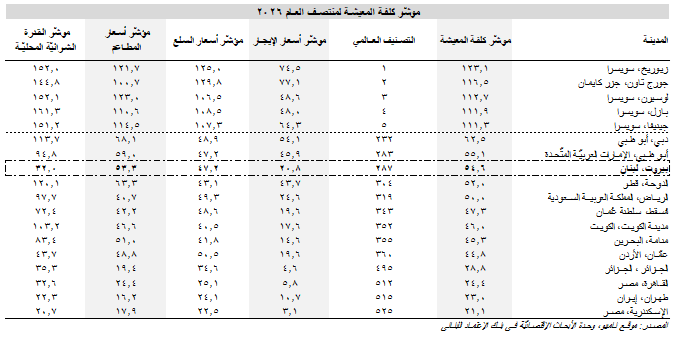
أصدر موقع نامبيو للإحصاءات مؤخّراً مؤشّر كلفة المعيشة العالمي، والذي يصنّف من خلاله المدن حول العالم بحسب نتيجة المؤشّر المذكور في كلٍّ منها عند مقارنته بأرقام مدينة نيويورك، إضافةً إلى نشره لإحصاءات عن أربعة مؤشّراتٍ أخرى ألا وهي موشّر أسعار الإيجار ومؤشّر أسعار السلع ومؤشّر أسعار المطاعم ومؤشّر القدرة الشرائيّة المحليّة في تلك المدن. وقد أظهرت الإحصاءات هيمنة أربعة مدن سويسريّة والتي إحتلّت أربعة من المراتب الخمسة الأولى مع حلول مدينة زوريخ في المرتبة الأولى عالميّاً بنتيجة 123.1 في المؤشّر (أي أنّ الأسعار في زيوريخ هي أعلى بنسبة 23.1% من الأسعار في مدينة نيويورك والتي إحتلّت المرتبة ال12) في حين حلّت لوسيرن في المرتبة الثالثة (نتيجة 112.7 في المؤشّر) وبازل في المرتبة الرابعة (نتيجة 111.9 في المؤشّر) وجينيفا في المرتبة الخامسة (نتيجة 111.3 في المؤشر). وقد أتت جورج تاون (جزر القمر) في المرتبة الثانية في المؤشّر بنتيجة 116.5. على صعيدٍ إقليميٍّ، برزت مدينة دبي كأغلى مدينة عربيّة عند مقارنة مستوى الأسعار فيها بالأسعار في مدينة نيويورك بحيث بلغ مؤشّر كلفة المعيشة فيها 62.5 (المركز العالمي: 232)، تبعتها مدينة أبو ظبي (مؤشّر كلفة المعيشة بلغ 55.1 والمرتبة 283 عالميّاً)، وبيروت (نتيجة المؤشّر 54.6 والمرتبة 287 عالميّاً). بالتالي، فإنَّ الأسعار في بيروت هي 45.4% أقلّ كلفة من تلك في مدينة نيويورك. كذلك سجّلت بيروت نتيجة 20.8 في مؤشّر أسعار الإيجار (ما يعني أنّ أسعار الإيجار في مدينة بيروت هي أقلّ كلفة من تلك في مدينة نيويورك بنسبة 79.2%) و47.2 في مؤشّر أسعار السلع (أيّ أنّ أسعار السلع في مدينة بيروت أقلّ كلفة بنسبة 52.8% من تلك في مدينة نيويورك) و53.3 في مؤشّر أسعار المطاعم (ما يعني أنّ أسعار المطاعم في مدينة بيروت هي أقلّ كلفة بنسبة 46.7% ممّا هي عليه في مدينة نيويورك) و32.00 في مؤشّر القدرة الشرائيّة (أيّ أنّ القدرة الشرائيّة في مدينة بيروت هي أدنى بنسبة 68.0% من تلك في مدينة نيويورك).
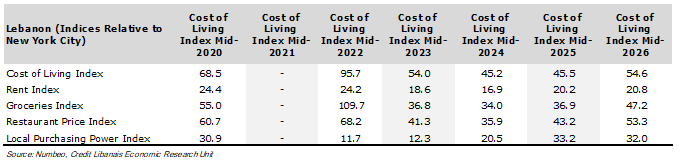
من ناحية أُخرى، يُظهر التطوّر التاريخي لمؤشّر كلفة المعيشة في بيروت أنَّ الأسعار في لبنان قد زادت بين منتصف الأعوام 2020 و2022 قبل أن تعود وتنخفض في منتصف الأعوام 2023 و2024، علماً أنّها إرتفعت في منتصف العام 2025 ومنتصف العام 2026. يمكن تعليل الإرتفاع في مؤشّر كلفة المعيشة في بيروت بين منتصف الأعوام 2020 و2022 بالأزمة الإقتصاديّة والماليّة التي مرّت بها البلاد وما خلّفته من غلاءٍ كبير في المعيشة جرّاء تدهور سعر صرف الليرة مقابل الدولار الأميركي. ولكنّ المؤشّر قد تراجع في منتصف العام 2023 إلى 54.0 ومن ثمّ إلى 45.2 في منتصف العام 2024 ليعود ويزيد إلى 45.5 في منتصف العام 2025 وإلى 54.6 في منتصف العام 2026 ما يمكن عزوه إلى التوتّرات الأخيرة في منطقة الشرق الأوسط.