




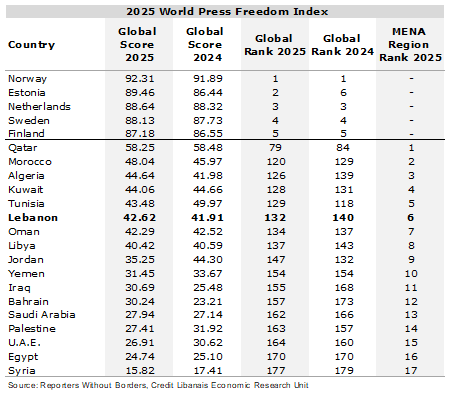
Reporters Without Borders (RSF) recently issued the 23rd edition of the World Press Freedom Index in which it ranked 180 countries across the globe according to their press freedom levels. More particularly, countries were assigned scores ranging from 0 to 100, with 0 being the worst possible score and 100 the best. More specifically, scores were grouped as follows: [0 – 40[: “very serious”, [40 - 55[: “difficult”, [55 – 70[: “problematic”, [70 – 85[: “satisfactory”, and [85 – 100]: “good”. RSF revealed that its’ methodology for the index centers around five indicators, namely “political context”, “legal framework”, “economic context”, “sociocultural context”, and “safety”. In this vein, RSF indicated that 42 countries were categorized as having “very bad” press freedom in the 2025 index, 48 were labeled as having “difficult” press freedom, 48 were classified as having “problematic” press freedom, 35 countries were grouped under “satisfactory” press freedom, and 7 were screened as having “good” press freedom. Furthermore, RSF revealed that 200 individuals (including 131 journalists and 5 media workers) were killed in the year 2025, in comparison with 56 in 2024. In detail, RSF unveiled that the Europe – Central Asia region suffered from an “unprecedented” economic crisis in 2025 aggravated by the sudden halt of American aid and the increasing influence of Russian propaganda. More specifically, the RSF noted that circa 90% of newsrooms in Ukraine (global rank: 62; score: 63.93) were surviving due to subsidies mostly from the US. The withdrawal of said subsidies, however, has threatened the reliable coverage of the war. When it comes to the Americas (North, Central and South), the RSF report pointed out that journalism continues to encounter structural and economic challenges, with 22 of the regions’ 28 countries witnessing a drop in their economic indicators. The Asia-Pacific region suffered the second worst freedom levels, with 20 out of 32 countries reporting a drop in their 2025 press freedom scores. The RSF commented that the MENA region remains the most dangerous in the world for journalists with every country (with the exception of Qatar) having a press freedom situation of either “difficult” or “very serious”. With regards to the ranking, RSF revealed that Norway topped the list of countries for yet another year with a press freedom score of 92.31, followed by Estonia (with a score of 89.46), the Netherlands (with a score of 88.64), Sweden (with a score of 88.13), and Finland (with a score of 87.18). Qatar ranked first in the MENA region and 79th in the world in the 2025 press freedom index with a score of 58.25, followed by Morocco which scored 48.04 and occupied the 120th place in the world, Algeria (3rd regionally and 126th globally; score of 44.64) and Kuwait (4th regionally and 128th globally; score of 44.06). Locally, Lebanon ranked 132nd in the world and 6th in the MENA region in the 2025 press freedom index with a score of 42.62, compared to a score of 41.91 and a world rank of 140th in the 2024 edition of the press freedom index. The RSF noted that the amelioration in Lebanon’s score and rank owes to the ceasefire agreement with Israel since the last quarter of 2024 and the formation of a new government in early 2025 that promised stability following years of political & economic deadlock, which could present an opportunity for the press to recover. Delving further into details, Lebanon scored 46.74 in the political indicator metric (global rank: 86), 48.64 in the legal framework indicator (global rank: 123), 30.31 in the economic context indicator (global rank: 154), 43.41 in the socio-cultural indicator (global rank: 138), and 43.99 in the safety indicator (global rank: 132).
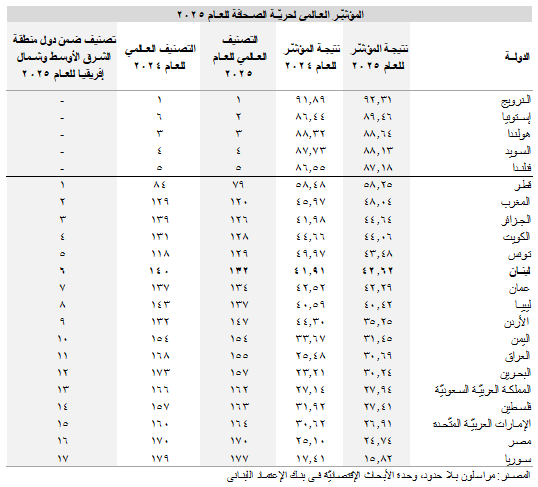
أصدرت منظَّمة مراسلون بلا حدود النسخة ال23 من المؤشِّر العالمي لحريّة الصحافة، والذي يصنِّف 180 دولة حول العالم وفقاً لمستويات حريّة الصحافة لديها. في التفاصيل، تمّ تصنيف البلدان بحسب نتيجتها في المؤشِّر، والتي تتراوح بين الصفر (أسوأ نتيجة ممكنة) والمئة (أفضل نتيجة ممكنة). وبشكلٍ أكثر تحديداً، تمّ تصنيف نتائج حريّة الصحافة على الشكل التالي: بين ]0 – 40]: صعبة جدّاً، بين [40 – 55]: صعبة، بين [55 – 70]: إشكاليّة، بين [70 – 85]: مرضية، وبين [85 – 100[: جيّدة. وقد كشفت منظَّمة مراسلون بأنّ منهجيّتها للمؤشّر تشمل خمسة ركائز ألا وهي "الإطار السياسي" و"الإطار القانوني" و"الإطار الإقتصادي" و"الإطار الإجتماعي" والإطار "الأمني". في هذا الإطار، أشارت منظَّمة مراسلون بلا حدود بأنّ 42 بلداً قد تمّ تصنيفهم ضمن خانة حريّة الصحافة الصعبة جدّاً، و48 ضمن خانة حريّة الصحافة الصعبة ، و48 ضمن خانة حريّة الصحافة الإشكاليّة، و35 ضمن خانة حريّة الصحافة المرضية، و7 ضمن خانة حريّة الصحافة الجيّدة. وكشفت الوكالة أيضاً أنّ 200 فرداً (منهم 131 صحافي وخمسة عاملين في وسائل الإعلام) قد لقوا حتفهم في العام 2025، مقارنةً مع 56 فرداُ في العام 2024. في التفاصيل، أشارت المنظَّمة إلى أنّ منطقة أوروبّا وآسيا الوسطى تعاني من أزمة إقتصاديّة غير مسبوقة والتي تفاقمت نتيجة التوقّف المفاجئ للمساعدات الأميركيّة وزيادة تأثير البروباغاندا (Propaganda) الروسيّة. وقد أشارت منظّمة مراسلون بلا حدود أنّ حوالي 90% من غرف الأخبار في أوكرانيا (التصنيف العالمي: 62؛ النتيجة: 63.93) كانت صامدة بسبب الإعانات (والتي بغالبيّتها آتية من الولايات المتّحدة الأميركيّة). ووفقاً للمنظّمة، فإنّ سحب تلك الإعانات قد يهدّد بموثوقيّة نقل وقائع الحرب من خلال وقائع الإعلام والصحافة. في السياق عينه، أفادت المنظَّمة بأنّ الصحافة في بلدان القارة الأميركيّة (الشماليّة والوسطى والجنوبيّة) لا تزال تعاني من تحدّيات هيكليّة وإقتصاديّة حيث أنّ 22 من 28 بلداً في المنطقة قد شهدت تراجعاً في مؤشّراتها الإقتصاديّة. أمّا فيما يختصّ بمنطقة آسيا والمحيط الهادئ، فقد سجّلت هذه المنطقة ثاني أسوأ أداء حيث أنّ نتائج حريّة الصحافة لدى 20 من 32 بلداً قد تراجعت خلال العام 2025. وقد كشفت المنظّمة بأنّ منطقة الشرق الأوسط وشمال إفريقيا لا تزال أخطر منطقة للصحافيّين في العالم حيث أنّ حريّة الصحافة في كلّ بلدان المنطقة (بإستثناء قطر) قد صنّفت إمّا في الخانة الصعبة أو الصعبة جدّاً. أمّا لجهة التصنيفات، فقد كشفت المنظّمة أنّ النرويج أتت في الصدارة بنتيجة 92.31 في مؤشّر حريّة الصحافة، تبعتها إستونيا (بنتيجة 89.46) وهولندا (بنتيجة 88.64) والسويد (بنتيجة 88.13)، وفنلندا (بنتيجة 87.18). أمّا لجهة دول المنطقة، فقد إحتلّت قطر المرتبة الأولى إقليميّاً والمركز 79 عالميّاً في مؤشِّر حريّة الصحافة للعام 2025 بنتيجة 58.25، تبعها المغرب والذي سجّل نتيجة 48.04 محتلّاً المرتبة 120 في العالم ومن ثمّ الجزائر (المرتبة الثالثة في المنطقة وال126 عالميّاً؛ نتيجة 44.64) والكويت (المرتبة الرابعة في المنطقة وال128 عالميّاً؛ نتيجة 44.06). محليّاً، إحتلّ لبنان المرتبة 132 في العالم والسادسة بين دول منطقة الشرق الأوسط وشمال إفريقيا في مؤشّر حريّة الصحافة للعام 2025 بنتيجة 42.62، مسجّلاً تحسّناً مقارنةً بنتائج مؤشّر العام 2024 حين سجّل نتيجة 41.91 محتلّاً المرتبة 140 عالميّاً. وقد أشارت المنظّمة أنّ التحسّن في نتيجة وتصنيف لبنان يعود إلى إتّفاق وقف إطلاق النار مع إسرائيل في أواخر العام 2024 وتشكيل حكومة جديدة في بداية العام 2025 والتي وعدت بتأمين الإستقرار بعد مرور سنوات على الأزمة السياسيّة والإقتصاديّة ما قد يتيح فرصة أمام الصحافة للتعافي. بالتفاصيل، فقد سجّل لبنان نتيجة 46.74 في الإطار السياسي (المركز العالمي: 86) ونتيجة 48.64 في الإطار القانوني (المركز العالمي: 123) ونتيجة 30.31 في الإطار الإقتصادي (المركز العالمي: 154) ونتيجة 43.41 في الإطار الإجتماعي (المركز العالمي: 138) ونتيجة 43.99 في الإطار الأمني (المركز العالمي: 132).