




Oxford Insights recently released the 2025 Artificial Intelligence (AI) Government Readiness Index in which it strives to provide answers to the extent to which a government can utilize AI to benefit the public. The index examines 69 indicators spread across 14 dimensions within six core pillars:
- Policy Capacity: the extent to which a government can design and implement effective AI policies in accordance with a clear, national policy vision for how AI benefits the country.
- AI Infrastructure: to what extent there is enough compute capacity and enabling technical infrastructure that the government can depend on over the long-term to develop and deploy AI.
- Governance: the extent to which a government has clear governance principles that it uses to shape how AI can be developed and adopted while safeguarding individuals’ rights and societal interests.
- Public Sector Adoption: the degree to which a government’s digital policy promotes testing of how AI can aid in solving public sector challenges.
- Development and Diffusion: to what extent there is a mature and available AI sector able to meet the needs of clients and promote long-term AI innovation.
- Resilience: the extent to which a government is able to tame the social, economic, and environmental challenges that result from the transition of societies towards a widespread AI adoption.
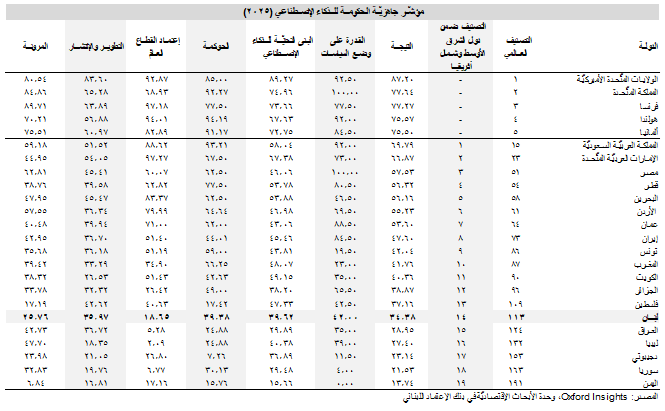
The 2025 version of the index highlights progress and identifies gaps in AI readiness, and provides “actionable insights” for governments looking to integrate AI into decision-making, policy-making, and public service delivery. The AI readiness index covers 195 countries around the globe, each assigned a score ranging between 0 and 100, with a higher score indicating that a country’s government is more ready to harness AI. North America was identified as the region with the highest AI government readiness index with a score of 79.75, followed by Western Europe (62.75), Eastern Europe (53.76), East Asia (49.14), the Middle East and North Africa (44.09), South and Central Asia (41.41), Latin America and the Caribbean region (34.00), the Pacific (30.39), and Sub-Saharan Africa (28.04). On a country level, the United States of America ranked first in the world with a score of 87.20, followed by the United Kingdom (score of 77.64), France (77.27), the Netherlands (75.57) and Germany (75.50). On a regional level, Saudi Arabia emerged as the country with the highest AI government readiness index, ranking 15th in the world with a score of 69.79, followed by the United Arab Emirates (ranked 23rd with a score of 66.87) and Egypt (ranked 51st with a score of 57.53) among others. On the other end of the list came each of Djibouti (global rank: 153; regional rank: 17; score: 23.14), Syria (global rank: 163; regional rank: 18; score: 21.53) and Yemen (global rank: 191; regional rank: 19; score: 13.74). Locally, Lebanon came in 113th in the world and 14th in the MENA region in the 2025 AI Government Readiness Index with a score of 34.38. More specifically, Lebanon scored best in the policy capacity (42.00) indicator, followed by the AI infrastructure (39.62), governance (39.38), development & diffusion (35.97), resilience (25.76), and public sector adoption (18.65) indicators.
أصدرت Oxford Insights مؤخراً مؤشّر جاهزيّة الحكومات للذكاء الاصطناعي للعام 2025 والذي يحاول الإجابة عن مدى جهوزيّة الحكومات الإستفادة من الذكاء الإصطناعي لخدمة المصالح العامّة. يقيس المؤشّر 69 مؤشّرات فرعيّة موزّعة على 14 بُعداً ضمن ستّة ركائز وهي:
- القدرة على وضع السياسات: إلى أيّ مدى قادرة الحكومة على تصميم وإعتماد سياسات فعّالة للذكاء الإصطناعي بالتزامن مع رؤية وطنيّة واضحة لكيفيّة إستفادة البلد من الذكاء الإصطناعي.
- البنى التحتيّة للذكاء الإصطناعي: إلى أيّ مدى تتوفّر القدرات الحاسوبيّة الكافية وقادرة على تمكين البنى التحتيّة التقنيّة والتي ستعتمد عليها الحكومة على المدى الطويل لتطوير وتطبيق الذكاء الإصطناعي.
- الحوكمة: إلى أيّ مدى الحكومة تتمتّع بمبادئ حوكمة تستعملها لتوجيه كيفيّة تطوير وإعتماد الذكاء الإصطناعي لمراعاة مصالح المواطنين الإجتماعيّة.
- إعتماد القطاع العامّ: إلى أيّ مدى سياسات الحكومة الرقميّة تشجّع تجربة إمكانيّة الذكاء الإصطناعي على المساعدة في حلّ تحدّيات القطاع العامّ.
- التطوير والإنتشار: إلى أيّ مدى يتوفّر قطاع للذكاء الإصطناعي ناضج قادر على تلبية حاجات المستخدمين وتشجيع الإبتكار في الذكاء الإصطناعي على المدى الطويل.
- المرونة: إلى أيّ مدى قادرة الحكومة على ضبط التحدّيات الإجتماعيّة والإقتصاديّة والبيئيّة الناتجة عن إنتقال المجتمعات تجاه إعتماد شامل للذكاء الإصطناعي.
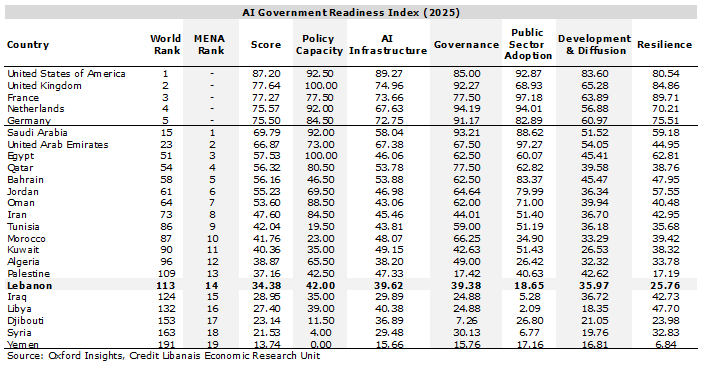
إنّ نسخة العام 2025 من المؤشّر تسلّط الضوء على التقدّم المحرز في جاهزيّة الحكومات لإعتماد الذكاء الإصطناعي وتحديد الثغرات، ما يمكن إستعماله لتأمين رؤى قابلة للتطبيق العملي للحكومات التي تبحث عن إستعمال الذكاء الإصطناعي لإتّخاذ القرارات والسياسات وتقديم الخدمات العامّة. يقيس المؤشّر مدى جاهزيّة الحكومات لإستخدام الذكاء الإصطناعي في 195 دولة حول العالم. وتتراوح نتيجة المؤشّر بين صفر ومئة، بحيث تشير النتيجة الأعلى إلى جاهزيّة الدولة بشكل أفضل لإعتماد الذكاء الإصطناعي. وبحسب المؤشّر، فإنّ أمريكا الشماليّة برزت كالمنطقة ذات الحكومة الأكثر إستعداداً للذكاء الاصطناعي بنتيجة 79.75 تلتها أوروبا الغربيّة (62.75) وأوروبا الشرقيّة (53.76) وآسيا الشرقيّة (49.14) ومنطقة الشرق الأوسط وشمال إفريقيا (44.09) وآسيا الوسطى والجنوبيّة (41.41) وأميركا اللاتينيّة ومنطقة الكاريبي (34.00) ومنطقة المحيط الهادئ (30.39) ومنطقة أفريقيا جنوب الصحراء الكبرى (28.04). على مستوى الدول، إحتلّت الولايات المتّحدة الأميركيّة المرتبة الأولى في العالم مسجّلةً نتيجة 87.20 في المؤشّر تلتها المملكة المتّحدة (77.64) وفرنسا (77.27) وهولندا (75.57) وألمانيا (75.50). على المستوى الإقليمي، برزت المملكة العربيّة السعوديّة كالدولة الأكثر إستعداداً لإستخدام الذكاء الإصطناعي محتلّةً المرتبة 15 في العالم بنتيجة 69.79 تلتها الإمارات العربية المتحدة (المرتبة 23 بنتيجة 66.87) ومصر (المرتبة 51 بنتيجة 57.53) للذكر لا الحصر. وفي الطرف الآخر من القائمة جاءت كل من دجيبوتي (المرتبة 153 في العالم وال17 في المنطقة بنتيجة 23.14) وسوريا (المرتبة 163 في العالم وال18 في المنطقة بنتيجة 21.53) واليمن (المرتبة 191 في العالم وال19 في المنطقة بنتيجة 13.74). محليّاً، جاء لبنان في المركز 113 في العالم وال14 في منطقة الشرق الأوسط وشمال إفريقيا في مؤشّر جاهزيّة الحكومة للذكاء الاصطناعي للعام 2025 بنتيجة 34.38. بالتفاصيل، سجّل لبنان أفضل نتيجة له في ركيزة القدرة على وضع السياسات (42.00)، تلتها ركائز البنى التحتيّة للذكاء الإصطناعي (39.62) والحوكمة (39.38) والتطوير والإنتشار (35.97) والمرونة (25.76) وإعتماد القطاع العامّ (18.65).